Contact center AI · Analysis
AI agent assist for contact centers: build a useful copilot
AI agent assist turns live conversations into grounded guidance. See how to design retrieval, approval, rollout tests, and contact center measurement.
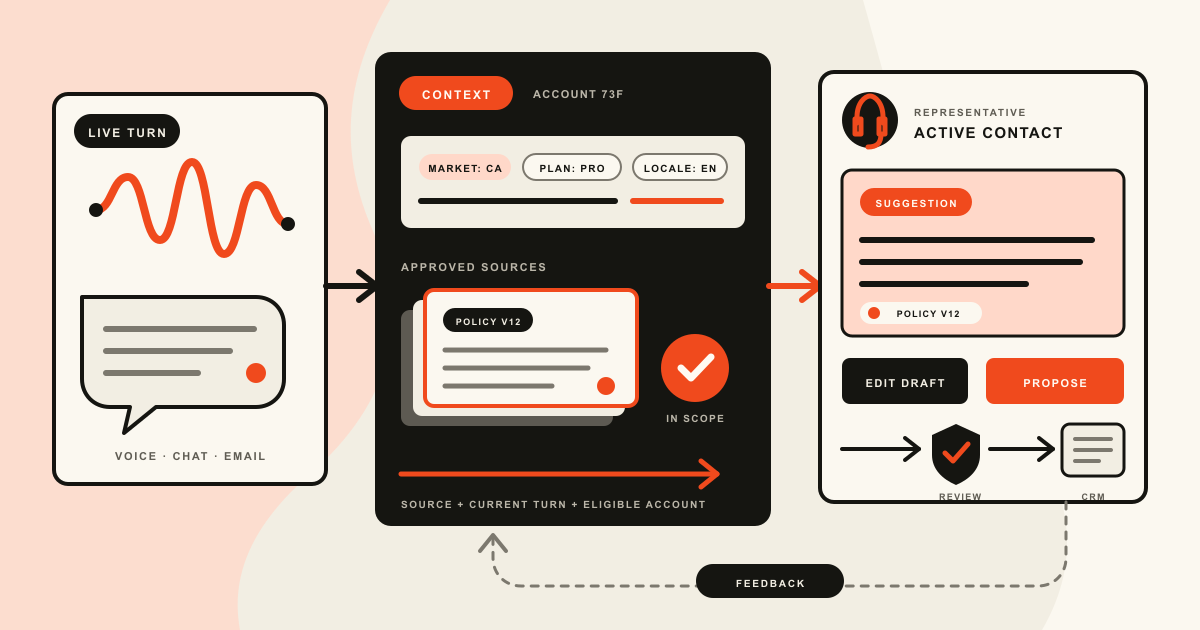
AI agent assist is software that follows a live customer conversation and helps a human contact center representative with relevant knowledge, suggested replies, summaries, checklists, or proposed system actions. A production implementation grounds each suggestion in approved sources and current customer context, shows the representative where the answer came from, and keeps consequential CRM or account changes behind explicit authorization. Start with a narrow queue and read-only knowledge retrieval. Test the complete system on representative conversations, including accents, silence, interruptions, policy exceptions, and stale documents. Measure answer correctness, source relevance, latency, dismissals, edits, transfers, repeat contacts, and compliance defects alongside handle time. The representative should remain able to ignore a suggestion, inspect its evidence, and recover when the assistant is slow or wrong.
AI agent assist gives a contact center representative help during a customer conversation. It may surface a policy article, draft a reply, fill a checklist, summarize the exchange, or propose the next step in a case. The customer is still speaking with a person. That boundary is easy to blur now that vendors use terms such as agent, copilot, assistant, and representative for different parts of the same product.
The presence of a large language model says little about whether the product will help. The representative needs the right evidence soon enough to act on it, without surrendering control of the customer record. A fluent answer that arrives after the representative has changed tabs is noise. A fast answer grounded in an outdated refund rule is worse. A one-click action that writes to the wrong account turns a suggestion problem into an authorization problem.
AWS, Microsoft, and Google now package similar capabilities under different names. AWS documents one mode in which AI talks directly to customers and another in which it detects intent, recommends responses, links to supporting documents, and proposes actions for a human agent. Microsoft Smart Assist interprets an active conversation and presents knowledge, similar cases, or next steps as dismissible cards. Google Cloud combines approved documents with the ongoing conversation and customer metadata to answer a human agent's question.
Those examples describe capabilities, not proof of business value. A contact center still has to design the data path, decide which suggestions deserve screen space, constrain write access, and test whether assistance improves the whole interaction rather than one convenient metric.
Define agent assist before comparing products
Agent assist is a human-facing layer inside the service workflow. It observes the conversation and available case context, then offers information or a proposed step to the person handling the contact. The representative decides what to say and, unless policy explicitly allows otherwise, what to execute.
That definition separates three products that procurement documents often mix together:
| Product | Who communicates with the customer? | Typical output | Safe default for actions |
|---|---|---|---|
| Agent assist | A human representative | Sources, suggested wording, summaries, prompts, proposed actions | Human reviews before external or account-changing effects |
| Customer-facing AI agent | The AI system | Direct replies and completed self-service tasks | Policy limits autonomy and hands off when the task leaves scope |
| Workflow automation | A deterministic process or service | Routing, field updates, notifications, scheduled work | Predefined rules and service authorization govern execution |
The boundary matters during escalation. A virtual agent may collect information before transferring a customer. Agent assist should inherit that transcript, the reason for transfer, verified identity state, and actions already attempted. It should not make the human ask the customer to repeat everything. At the same time, a transcript supplied by another model is context, not unquestionable fact. The representative needs access to the original conversation and authoritative account data.
Agent assist can be proactive or requested. A proactive system watches each turn and decides when to surface a card. A requested system waits for the representative to ask a question or trigger a summary. Proactive help can save more searching, but every false interruption competes with the customer for attention. Requested help has a clearer signal of need, though it may arrive too late for a mandatory disclosure or a time-sensitive next step.
A sensible first scope is narrower than the vendor feature list. Pick one queue, one channel, a controlled set of documents, and one or two jobs such as knowledge retrieval and after-contact summaries. State what the assistant will not do. If it cannot change an address, calculate an exception, or commit a refund, the interface should make that limitation obvious.
Trace the data path from conversation to suggestion
Real-time agent assist is a latency-sensitive retrieval and decision system wrapped around a contact center desktop. The model is one component. Most failures originate in the context sent to it, the documents it can retrieve, or the way its output reaches the representative.
A vendor-neutral data path looks like this:
voice or digital turn
  -> transcript and channel events
  -> authorized customer and case context
  -> intent, entity, and policy triggers
  -> scoped knowledge retrieval
  -> answer, source, or proposed action
  -> policy and confidence filters
  -> representative workspace
  -> feedback, audit event, and outcome
For voice, the system consumes streaming audio or a live transcript. For chat, email, and messaging, it receives text plus channel events such as transfer, hold, or conversation end. Transcription is not a transparent input. Product names, account codes, negation, numbers, and accents can change the meaning of a query. Keep timestamps and speaker identity so evaluators can trace a bad suggestion to the actual input rather than only the cleaned transcript.
The context service should assemble a bounded envelope for each suggestion. It may contain the verified customer ID, queue, product, locale, entitlement, open case, recent events, and the latest conversation turns. Pull authoritative fields from systems of record rather than asking the model to infer them from speech. Do not send every available CRM field because it might be useful. Extra data increases privacy exposure and gives retrieval more ways to choose the wrong account or policy.
Triggering deserves its own logic. Some events are deterministic: a regulated phrase requires a disclosure, a transfer opens a handoff summary, and a conversation end starts after-contact work. Other triggers depend on intent detection or a model. Keep the two paths distinguishable in logs. When a mandatory checklist item fails, the team needs to know whether the source event never arrived, the trigger missed it, or the interface hid the card.
Retrieval should return source identity, version, access class, and relevant passage with the answer. This is the same control problem described in RAG versus agentic RAG: adding a planning loop does not repair weak source selection. If the assistant can call tools or search multiple systems, the agent RAG architecture needs observable routing and stopping rules rather than an open-ended hunt for something plausible.
Measure delivery in two parts. Machine latency runs from the triggering turn to a rendered suggestion. The second interval ends when a representative sees, understands, and applies it. A technically impressive answer that appears beneath four old cards can still arrive too late to help.
Ground answers in a governed knowledge layer
Agent assist exposes the condition of the knowledge base. Duplicate procedures, expired campaigns, regional exceptions, and documents without owners become conflicting suggestions. The model may make the conflict sound tidy, but it cannot decide which policy has authority unless the system supplies that rule.
Each source should have an owner, effective date, review date, audience, locale, product scope, and access class. Index the procedural content that representatives may use, not every file the organization can technically connect. Exclude drafts, meeting notes, obsolete versions, and customer records from the shared knowledge corpus unless a specific retrieval path and permission model require them.
Retrieval filters should follow the case context. A representative handling a Canadian business account should not see a US consumer policy simply because its wording is a closer semantic match. Apply hard filters for tenant, market, product, language, plan, and document state before semantic ranking. The model may then synthesize across the eligible passages.
Show the source near the suggestion. A generic "AI answer" label asks the representative to trust the model. A linked policy title, effective date, and quoted passage let the representative verify it while the customer waits. Google Cloud's current Generative Knowledge Assist API can return document metadata, answer records, clicked URIs, and whether an answer was copied. Those fields are useful building blocks, but the contact center still has to define which metadata proves authority in its own environment.
Freshness needs an enforcement rule. When a source expires, either remove it from retrieval or mark its answers unavailable. Quietly leaving old and new versions in the index produces a probabilistic policy selector. Reindexing should create a versioned event so a quality regression can be tied to the corpus that caused it.
Build a no-answer path on purpose. If retrieval finds no eligible source, the assistant can say that it found no approved answer and offer a manual search or escalation. It should not fill the silence from general model knowledge. That fallback will look less magical in a demo and behave better in a refund dispute.
Google's own product history is a reminder to verify feature status rather than rely on old comparisons. Its Agent Assist release notes announced that Article Suggestion and FAQ Assist would be removed on April 1, 2026, directing users to Generative Knowledge Assist. Treat named features, models, connectors, and regional availability as dated procurement facts.
Keep suggested actions inside an authorization boundary
Early agent assist products concentrated on reading and suggesting. Newer products can also update a case, create a note, run a macro, or invoke an external tool. Microsoft describes a service assistant that can search approved knowledge and complete supported case tasks, while AWS documents recommended actions alongside real-time responses. Once a suggestion can cause a side effect, the architecture needs separate proposal and execution paths.
Use a simple capability ladder:
- Read-only context: retrieve a case, policy, status, or prior interaction.
- Drafted output: prepare a reply, summary, note, or form value that a person can edit.
- Proposed action: resolve identifiers and arguments, then show exactly what would change.
- Approved execution: run one frozen proposal after policy and authorization checks.
- Standing automation: allow only a narrow, reversible operation under explicit limits.
The first deployment rarely needs the fifth step. Drafting saves work without giving the assistant authority over the record. When actions are added, bind approval to the exact customer, tool, arguments, and proposed change. If the representative edits the amount or destination, validate a new proposal. The human-in-the-loop approval pattern explains how to persist and resume that decision without letting the model approve itself.
Tool credentials should belong to the application and preserve the representative's authorization scope. Do not give the model a broad service account merely because the user interface sits inside an authenticated desktop. For external tools, apply the trust boundaries in MCP security architecture: validate inputs, restrict destinations, record calls, and treat tool descriptions as untrusted metadata rather than policy.
Some actions can remain deterministic even when a model recommends them. The assistant may detect that a replacement workflow is relevant, while application code checks eligibility, selects the verified order, calculates allowed options, and prepares the transaction. This split keeps language understanding probabilistic and business enforcement explicit.
Design the workspace for divided attention
A representative listens, speaks, reads account history, updates a case, and manages the customer's mood at the same time. Agent assist enters an already crowded screen. More suggestions can reduce performance even when each card is individually reasonable.
Rank by immediate usefulness and consequence. A required disclosure should displace a background summary. A verified answer to the customer's current question should replace stale cards from the previous topic. Microsoft lets representatives dismiss Smart Assist recommendations, which is basic but important: the person needs a low-friction way to clear irrelevant help.
Keep four things visible on an answer card:
- what the assistant thinks the customer needs;
- the proposed wording or next step;
- the authoritative source and its effective scope;
- the action available to the representative, such as copy, insert, inspect, dismiss, or propose.
The card should not dump hidden chain-of-thought or a long confidence explanation into the workspace. Show evidence that can be checked: source passage, account field, policy rule, calculation input, or tool result. If a confidence threshold suppresses suggestions, log it for evaluators rather than converting a noisy score into a badge that representatives learn to ignore.
Make editing normal. Suggested replies should enter the composer as drafts instead of going straight to the customer. Summaries should separate customer issue, actions taken, result, and follow-up fields so the representative can correct one part. A correction should remain attributable to the person, not folded into an audit record that implies the model wrote the final version.
Plan the degraded state. The contact center must continue when transcription lags, retrieval is unavailable, or a model endpoint times out. Preserve manual search, normal case controls, and the original conversation view. Do not let an assist outage block a representative from serving the customer.
Evaluate the complete system before launch
A model benchmark does not test a contact center deployment. Evaluation must include transcription, context assembly, retrieval, generation, filters, interface timing, and any proposed action. It also needs examples from the queue where the product will run.
Create a versioned test set from permissioned, appropriately protected interactions. Cover common intents, but reserve substantial space for the cases that break shortcuts: customers who change topics, corrections to account numbers, overlapping speakers, silence, poor audio, code-switching, angry language, rare products, outdated policies, missing entitlements, and requests that should produce no answer. Use synthetic or carefully redacted cases when production data cannot be used safely, and document what those cases fail to represent.
Google recommends a golden set of roughly 20 to 30 examples for its generative knowledge assist feature. That can start configuration work. It is too small to establish production reliability across queues, accents, products, and exceptions. NIST's Generative AI Profile advises against extrapolating performance from narrow or anecdotal assessments and calls for testing under conditions similar to deployment.
Score stages separately before combining them:
| Stage | Question | Useful measures |
|---|---|---|
| Transcript | Did the system capture the material words and correct speaker? | word and entity error rates, number accuracy, turn attribution |
| Trigger | Did help appear for the right event? | recall for required prompts, false prompt rate, duplicate rate |
| Retrieval | Did it select an eligible and authoritative source? | recall at k, source precision, scope violations, stale-source rate |
| Answer | Does the suggestion follow the source and answer the current need? | correctness, completeness, unsupported-claim rate, reviewer severity |
| Delivery | Did it arrive while it could still help? | end-to-end latency percentiles, late-card rate, render failures |
| Action | Did the proposal target the right record with valid arguments? | schema failures, authorization failures, edit rate, duplicate prevention |
Have service experts judge answers with the source and conversation visible. Blind preference between two fluent replies can reward style over policy accuracy. Record why an answer failed and which component owned the failure. "The AI was wrong" is not a repairable category.
Test the human interaction too. NIST recommends involving end users and operators in prototypes, monitoring human and generative AI outcomes, and reviewing sources and citations both before deployment and during operation. Run realistic sessions with experienced and newer representatives. Watch whether they notice source scope, correct summaries, over-trust polished language, or spend longer reading cards than they would searching manually.
Privacy testing belongs in the release gate. Contact streams may contain identity data, health details, payment information, authentication answers, or facts about another person. Verify which fields leave each system, what is logged, how long it remains, who can replay it, and whether feedback records reproduce sensitive text. Google Cloud, for example, exposes a setting related to storage of redacted agent search queries. "Redacted" still requires a review of what the implementation removes. NIST calls for periodic monitoring of generated content for PII or sensitive-data exposure.
Roll out by capability, not by a single launch date
Start in shadow mode. Generate suggestions and record timing without showing them to representatives. This finds missing events, source collisions, and latency spikes without changing live behavior. Review failures by queue and intent instead of relying on one average.
The next stage can expose read-only knowledge suggestions to a small group. Choose representatives who will report bad assistance rather than politely work around it. Give them a clear feedback control and a manual fallback. Google Agent Assist supports structured answer feedback such as displayed, clicked, copied, and correctness fields. Instrumentation like this helps, but a click is not a verdict that the answer was correct.
Add drafting after retrieval is stable. Replies, notes, and summaries should remain editable and unsent. Compare the generated version with the final saved or sent text, while respecting employee monitoring rules and local law. Large edits may signal poor grounding, an unsuitable tone, missing context, or a representative preference. Sample the actual cases before deciding which explanation fits.
Introduce proposed actions last, one workflow at a time. Begin with reversible changes and explicit review. Set per-queue kill switches, rate limits, and a fast route back to manual operation. Link every suggestion and action to the same evidence trail used for AI agent observability: conversation turn, context version, retrieved source, model and prompt version, policy decision, representative response, and system result.
Release criteria should be stated before the pilot. For example, a team may require zero cross-tenant source leaks, no unauthorized writes, a maximum stale-source rate, a target for supported-answer correctness, and an upper latency percentile. The exact thresholds depend on harm and workflow. They should not be chosen after seeing the dashboard.
Measure value without letting handle time dominate
Average handle time is visible and financially convenient, so it often becomes the headline metric. Used alone, it can reward rushed conversations, premature transfers, and incomplete notes. Agent assist should be evaluated as a service intervention, not a typing shortcut.
Track three layers together:
| Layer | Examples |
|---|---|
| System quality | availability, latency percentiles, source coverage, unsupported claims, stale answers, action failures |
| Representative behavior | suggestion exposure, dismissals, copies, edits, manual searches, overrides, repeated prompts |
| Customer and operational outcome | first-contact resolution, transfers, repeat contacts, reopen rate, compliance defects, after-contact work, quality review scores |
Segment the results. An overall improvement may hide worse performance for one language, queue, product, or new-hire cohort. Compare assisted and unassisted work carefully because easy contacts may be more likely to receive a good suggestion. A staged rollout or randomized eligible cohort can provide stronger evidence than a before-and-after average, provided the operation and employee policies allow it.
Acceptance rate needs context. A low rate may mean suggestions are poor, late, redundant, or hard to apply. A very high rate may mean the feature is useful, or that representatives have learned to accept polished text without checking it. Review a sample of accepted, edited, dismissed, and ignored suggestions against source truth.
Use model measures to explain customer outcomes, not as substitutes for them. Better retrieval precision matters because it should help a person resolve the contact correctly. If correctness rises but repeat contacts also rise, investigate the metric definition and the workflow. If handle time falls while compliance defects increase, the assistant has shifted cost rather than removed it.
Production monitoring should trigger action. Define who owns stale documents, who can disable a model or feature, how representatives report a dangerous suggestion, and how incidents reach security, privacy, compliance, and service operations. Preserve the relevant trace long enough to reconstruct the event, with access controls appropriate to the conversation data.
Ask vendors questions that survive the demo
Feature checklists flatten important differences. A more useful procurement review follows one customer turn through the system and asks what can be proved at each boundary.
Ask for specific answers:
- Which channels and languages are generally available for each feature in the required regions?
- What event triggers a suggestion, and what are the measured end-to-end latency percentiles on comparable traffic?
- How are knowledge sources filtered by tenant, market, product, entitlement, locale, and effective date?
- Can the representative inspect the source passage and dismiss or edit the output?
- What happens when no eligible source exists or the model endpoint is unavailable?
- Which conversation, search, prompt, answer, feedback, and action data is stored, where, and for how long?
- Can administrators disable query logging, set retention, use customer-managed keys, and export audit evidence?
- Which actions are read-only, proposed, approved, or autonomous, and whose authorization reaches the downstream service?
- How are model, prompt, connector, and knowledge-index changes versioned and tested before release?
- Can the customer run an independent test set and retrieve per-example results rather than a single score?
Request documentation for the exact edition and release status being purchased. In fast-moving contact center suites, an old article may describe a retired retrieval feature while a demo uses a preview model. Note every preview dependency, region limit, connector requirement, and fallback in the decision record.
A deployment is ready when a representative can get an authoritative next step quickly, inspect its basis, and continue working when the assistant fails. Start with current sources, scoped context, visible evidence, bounded actions, and a reliable manual route. Generated phrasing can improve over time. Retrofitting the control path is much harder.
Sources and methodology
This article draws on the primary documentation and research listed below. An editor reviewed the technical claims and wording before publication.
- Google Cloud Agent Assist: Generative knowledge assist — official knowledge grounding, conversation context, metadata, query logging controls, source metadata, and answer feedback fields
- Google Cloud Agent Assist: Best practices for generative knowledge assist — official golden-set guidance and knowledge-assist evaluation recommendations
- Google Cloud Agent Assist: Send feedback — official answer-record feedback events and correctness fields
- Google Cloud Agent Assist release notes — current feature status, deprecations, evaluation capabilities, and integration changes reviewed on 2026-08-03
- AWS: Use Connect AI agents for real-time assistance — official distinction between autonomous self-service and assistance for human agents, with knowledge, response, action, and workspace capabilities
- Microsoft Learn: View smart assist suggestions — official real-time recommendation cards, dismissal behavior, and next-step suggestions in the representative workspace
- Microsoft Learn: Overview of Service Agent — official case context, grounded knowledge, supported service actions, role-based access, and workspace behavior
- NIST AI 600-1: Generative AI Profile — primary guidance on representative testing, source verification, privacy monitoring, human feedback, staged release, and risk controls