Agentic RAG · Analysis
RAG vs agentic RAG: when the control loop is worth it
RAG vs agentic RAG compared on retrieval quality, latency, cost, reliability, and task fit, with a practical rule for choosing an architecture.
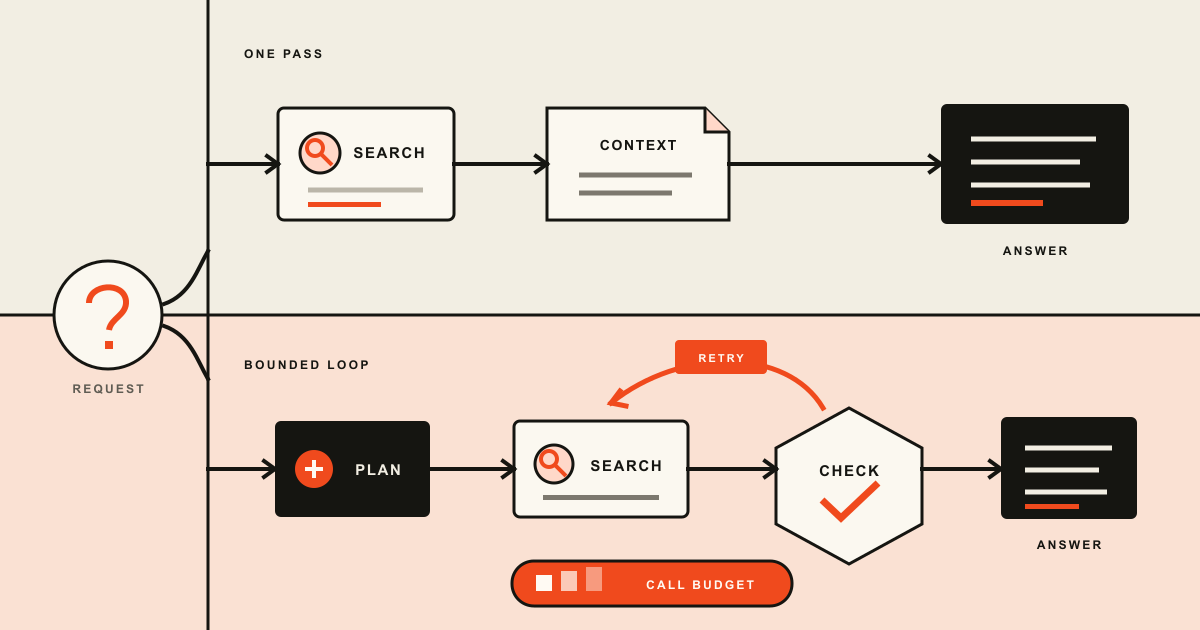
Choose standard or enhanced RAG when a request maps predictably to one retrieval path and the main work is improving search, reranking, and answer grounding. Choose agentic RAG when requests require dynamic source selection, dependent searches, or evidence-based retries. The control loop is worth its extra latency, cost, and failure modes only if tests show that those decisions recover useful evidence often enough to beat a fixed baseline. For many teams, the best design is hybrid: a fixed path by default and a bounded agent loop for the smaller set of requests that need it.
The useful answer to RAG vs agentic RAG is not that one is old and the other is smarter. Standard RAG runs a retrieval path chosen in advance. Agentic RAG can choose and repeat retrieval actions while a request is in progress. That added control can solve questions a fixed path handles poorly, but it also creates more model calls, more possible failure paths, and a harder system to test.
The choice should begin with the information task. If most questions need one well-defined index and one search, improve that path before adding an agent. If the next search depends on what the previous search found, or the correct source cannot be known from the initial question, a bounded control loop may be justified.
There is also a useful middle ground: enhanced RAG. A deterministic pipeline can route requests, rewrite queries, combine keyword and vector search, rerank documents, and validate citations without giving a model request-time control of the workflow. In practice, the serious comparison is among basic RAG, enhanced RAG, and agentic RAG.
Compare three systems, not two
The original RAG paper combined a generator with retrieved non-parametric memory. In a typical product implementation, code accepts a question, retrieves passages from a predetermined source, inserts them into a prompt, and generates an answer. The retrieval step happens because the application says it must happen.
That basic design is only the starting point. Teams commonly add deterministic improvements:
- an intent router that selects a known index or skips retrieval for greetings;
- query expansion or rewriting using fixed rules or a model call;
- metadata filters, hybrid search, and a reranker;
- context compression, citation checks, and answer validators;
- a fallback when retrieval returns no acceptable evidence.
This is enhanced RAG. Individual nodes may use language models, but application code still owns the sequence and stop condition. The path is known before the request begins.
Agentic RAG moves some sequence decisions into a request-time loop. A coordinator can decide whether to retrieve, choose from allowed tools, decompose a question, inspect an observation, rewrite a weak query, and search again. The ReAct paper established the influential pattern of interleaving reasoning, actions, and observations. Self-RAG explored adaptive retrieval and critique rather than retrieving a fixed number of passages for every input.
The defining feature is not a particular framework or a collection of agents. It is the back edge in the workflow: evidence from one step can change the next retrieval decision. One coordinator in a small state graph can be agentic. A large pipeline with several model calls can remain deterministic.
These definitions matter because an agent is not the only way to fix weak retrieval. If the failure comes from poor chunking, stale documents, missing metadata, or an ineffective reranker, wrapping the pipeline in a loop lets the system repeat a bad search more creatively. Trace Brief's agent RAG architecture guide covers the components and control boundaries of the loop in detail. This article focuses on whether that loop should exist at all.
RAG vs agentic RAG, side by side
The central tradeoff is control flexibility against operational predictability.
| Dimension | Standard or enhanced RAG | Agentic RAG |
|---|---|---|
| Retrieval path | Chosen by application code before the request | Chosen or revised from request state and observations |
| Source selection | One source or deterministic routing rules | Model-assisted choice among allowed retrieval tools |
| Number of searches | Usually fixed | Variable, within explicit limits |
| Complex questions | Handled by a predefined decomposition or one broad search | Can create dependent subquestions and adapt as evidence arrives |
| Weak results | Fixed fallback, alternate query, or failure state | Can grade evidence, rewrite the query, switch tools, and retry |
| Latency and cost | Easier to predict, cache, and budget | Trajectory-dependent and usually higher |
| Evaluation | Retrieval set, answer quality, citations, and fixed stages | All fixed-pipeline tests plus tool choice, arguments, path, retries, and stop reason |
| Debugging | Smaller set of paths and clearer stage ownership | More paths, model-mediated decisions, and state transitions |
| Security surface | Primarily the known retrieval service and generator | Every tool, observation, state field, and loop transition adds a boundary |
| Best fit | Repeated questions with a stable source and retrieval recipe | Variable questions requiring source choice, dependent lookup, or recoverable search |
Standard RAG is not necessarily one naive vector query. A fixed pipeline can be sophisticated. It can fan out to keyword and semantic search in parallel, merge results, run a cross-encoder reranker, and reject an answer whose citations do not support its claims. Those are usually easier to evaluate than a coordinator deciding at runtime which operation to try.
Agentic RAG is not automatically autonomous in the broad sense. Retrieval tools can be read-only, their arguments can use strict schemas, and the runtime can enforce a maximum of two searches. This bounded form is often more useful than an open-ended research agent. The model proposes a next step; deterministic code checks that the step is permitted and within budget.
The distinction also affects user experience. A fixed path can offer stable response times and clear error messages. An agent path may resolve a difficult question that would otherwise fail, but users can see variable waits and partial answers. Products should expose a sensible deadline and a truthful terminal state such as insufficient evidence or source unavailable. "Keep searching until confident" is not a stop condition.
What current evidence actually shows
The strongest reason to avoid a simple winner narrative is that agentic decisions help some stages and hurt others.
A 2026 study titled "Is Agentic RAG worth it?" compared three approaches across Natural Questions, FIQA, CQADupStack English, and FEVER. Its enhanced pipeline used a semantic router, HyDE query rewriting, retrieval, and an explicit reranker. Its agentic system let a model decide whether to use the RAG tool and whether to rewrite and retrieve again. The authors deliberately used one retrieval tool so the comparison would isolate control behavior rather than the benefit of a larger tool catalog.
Agentic rewriting produced the best average NDCG@10 in the reported query-rewriting experiment: 55.6, compared with 52.8 for enhanced RAG and 50.3 for the naive baseline. The improvement was not uniform, but it shows a credible benefit from adapting a query to the request.
The document-refinement result went the other way. The enhanced pipeline with explicit reranking averaged 49.5 NDCG@10, while the agentic configuration averaged 43.9. The agent retried retrieval in only 10% of cases, and 53% of those retries left the returned document set unchanged. A loop existed, but it often did not create new evidence.
Intent handling also varied by dataset. The agentic system was slightly better on FIQA and CQADupStack English, but on FEVER its F1 score was 64.6 versus 87.9 for enhanced RAG. The reported agentic recall on FEVER was 49.3. That is an important failure mode: a model that may skip retrieval can answer smoothly while missing requests that require external evidence.
The flexibility had a measurable operating cost. Across the study, the agentic approach used about 3.3 times as many input tokens, 1.9 times as many output tokens, and 1.5 times as much time on average. The authors describe costs as reaching 3.6 times the alternatives in their tested setup. Their conclusion favors hybrid designs rather than treating agentic RAG as a universal replacement.
These figures are evidence about the evaluated systems, models, prompts, and datasets, not permanent ratios for every deployment. A multi-source support agent, a legal research workflow, and a single-index benchmark present different opportunities. The broader lesson is more durable: evaluate the decisions separately. An agent may improve query formulation while making worse retrieve-or-skip choices. An explicit reranker may outperform model judgment even inside an otherwise agentic system.
Current Microsoft architecture guidance reaches a compatible practical conclusion. It recommends standard RAG when one query against one index is enough and agentic retrieval for multistep questions, dynamic source choice, decomposition, iterative refinement, or retrieval followed by action. It also warns that each reasoning step adds latency, tokens, and complexity. The UK government's current Agentic RAG overview similarly treats traditional RAG as a strong option for simple, fast, lower-cost retrieval and highlights loop, debugging, bias, and cost risks in agentic designs.
An agent can improve a specific retrieval decision without improving the whole system. Measure routing, rewriting, retrieval, retry value, answer support, cost, and latency separately.
Where a control loop can improve quality
The loop is useful when an observation changes what the system should do next. Three patterns meet that test.
First, source choice is genuinely ambiguous. An enterprise assistant may have separate tools for product manuals, incident records, contracts, and account data. The wording of a request can reveal the correct source, but only if the router understands the task and the available tools. An agent can select among those tools and combine results. The benefit comes from the source boundary, not from repeatedly searching the same general index.
Second, the question contains dependent information needs. "Did the service-level agreement apply during the outage?" may require identifying the customer's contract, finding the incident window, and then comparing the two. The arguments for the second search depend on the first result. A fixed workflow can implement this exact case, but an agent becomes attractive when the dependencies vary across a broad set of questions.
Third, evidence quality is observable and recoverable. If the first search returns no documents, omits a required entity, or produces low relevance scores, the system can take a distinct next action. It might restore a dropped date, use an identifier found in a result, switch from semantic to keyword search, or search a second approved corpus. A retry is valuable only when the evaluator can detect a correctable problem and the new action has a reasonable chance of changing the evidence.
Several popular rationales are weaker:
- "The question is complex" is too vague. A deterministic decomposition may handle the complexity better.
- "The model can reason" does not prove it can judge retrieval quality or know when evidence is missing.
- "We need better accuracy" identifies an outcome, not the failed stage. Retrieval data and evaluation should locate the bottleneck first.
- "Agentic is the modern architecture" is not a task requirement.
Use claim-level diagnostics to identify the bottleneck. RAGChecker separates retrieval and generation problems, including whether claims are supported and whether retrieved context contains the required information. If evidence recall is poor because relevant documents never enter the index, an agent cannot retrieve them. If evidence is present but the generator ignores it, another search is unlikely to help.
The best agentic systems keep deterministic specialists. Use a normal search engine for ranking, a reranker for relevance, policy code for permissions, and validators for schemas. Let the coordinator choose among these capabilities where the choice depends on the request. Do not ask one language model to imitate every layer.
Cost, latency, reliability, and debugging
The price of an agentic loop extends beyond an extra planning prompt. Every turn may add a model request, a search, reranking, network time, more state, and a larger synthesis context. The number of turns varies by request, so tail latency and per-request cost matter more than a single average.
A simple budget model makes the difference visible:
| Cost term | Fixed RAG | Agentic RAG |
|---|---|---|
| Router or planner calls | Zero or a fixed small number | At least one, sometimes repeated |
| Retrieval and reranking | Known count | Variable count based on the path |
| Prompt growth | Mostly retrieved context | Retrieved context plus observations and state summaries |
| Cacheability | High for stable, scoped queries | Lower when the path depends on state and prior results |
| Tail latency | Dominated by known stages | Dominated by the slowest valid trajectory |
Set budgets for model turns, tool calls, documents, context tokens, wall-clock time, and spend. An iteration limit alone is not enough because one turn can fan out to several expensive searches. Record which retries produce new source IDs and which change the final answer. A retry rate can look active while contributing little, as the 2026 comparison demonstrated.
Reliability changes because the path becomes another output. A fixed pipeline has a small set of stage failures. An agent can choose the wrong tool, pass valid but unhelpful arguments, accept weak evidence, repeat a search, exhaust its budget, or stop too early. Low sampling temperature does not remove these possibilities. Model versions, indexes, hosted services, and source content all change.
Evaluation therefore needs trajectory tests in addition to answer tests. For each representative task, record the allowed tools, required evidence, forbidden sources, maximum calls, expected terminal states, and acceptable alternate paths. Measure source-selection accuracy, argument validity, evidence recall, citation entailment, unnecessary calls, recovery after empty results, stop reason, latency, and cost.
The current LangGraph agentic RAG example makes the extra path explicit: decide whether to retrieve, grade documents, generate or rewrite the question, then follow conditional edges. That transparency is useful. If a framework hides tool calls and retries inside a generic agent executor, operations teams lose the evidence needed to explain regressions.
Security grows with the tool surface. Retrieved text is untrusted data and can contain instructions aimed at the model. Tool arguments need typed validation. User and tenant filters must come from trusted identity context, not model-generated text. Keep write actions outside the retrieval loop or behind a separate approval state. These controls matter even for a read-only assistant because traces and retrieved passages can contain sensitive material. The same scoped-control principle appears in Trace Brief's guide to AI agent identity and attestation.
Match the design to the task
Architecture selection becomes easier when phrased as concrete request patterns.
| Request pattern | Better starting point | Why |
|---|---|---|
| FAQ assistant over one curated help center | Enhanced RAG | Stable source, predictable retrieval, strong caching opportunity |
| Policy lookup where every answer must cite one controlled corpus | Enhanced RAG | Deterministic retrieval and abstention are easier to audit |
| Support assistant that may need manuals, account data, and incident history | Bounded agentic RAG | Source choice and search arguments vary by request |
| Investigation where one finding supplies identifiers for the next search | Bounded agentic RAG | Later retrieval depends on earlier evidence |
| Broad research across many changing public sources | Agentic workflow with strict budgets and provenance | Decomposition and iterative discovery can create new evidence |
| High-volume simple lookup with tight response-time targets | Enhanced RAG | The agent's planning overhead has little opportunity to pay back |
| Workflow that retrieves evidence and then changes external state | Separate retrieval and action stages | Evidence errors should not flow directly into an irreversible action |
Volume changes the economics. A planning call that costs little in a prototype can dominate a high-volume service. Conversely, a lower-volume investigation product may accept a slower path if it finds evidence that a single search misses. Compare cost per successfully supported answer, not cost per request alone. A cheap answer with no required evidence is not a success.
Risk changes the design too. In a low-impact discovery tool, the system may show tentative sources and let the user judge them. In legal, financial, employment, health, or public-service contexts, source authorization, coverage, freshness, and human escalation need stronger controls. More autonomous searching does not relax the burden of evidence.
Avoid routing every request through the agent for consistency. A hybrid front door can send common, well-classified requests to a fixed pipeline and reserve the loop for requests with multiple sources, dependent subquestions, or a failed first pass. The final response can look consistent even when the internal path differs.
A staged path from RAG to agentic RAG
The safest migration begins by making the fixed system measurable.
- Establish a fixed baseline. Build a representative test set with expected evidence, supported claims, answer dispositions, latency, and cost. Separate retrieval failures from generation failures.
- Improve the retrieval foundation. Fix document coverage, access filters, chunking, metadata, hybrid search, reranking, freshness, and citation validation. These investments benefit either architecture.
- Add deterministic routing. Split clearly different corpora behind typed, read-only tools. Use rules or a classifier when the route can be evaluated directly.
- Introduce one adaptive decision. Let a coordinator decide whether to retrieve, choose a source, or retry after a measurable evidence failure. Do not add all three at once.
- Bound and trace the loop. Enforce tool allowlists, strict argument schemas, query deduplication, call and token limits, deadlines, stop reasons, and evidence provenance.
- Run fixed and agentic paths side by side. Compare evidence recall, supported-answer rate, routing, retry yield, tail latency, and cost on the same requests.
- Expand only where the loop wins. Route the request classes with demonstrated gains to the agent. Leave the rest on the fixed path.
This staged design preserves a counterfactual. If the agent path regresses after a model or prompt change, the fixed path is still available as a fallback and a comparison. It also prevents teams from attributing every improvement to agency when the actual gain came from a better index or reranker.
Instrument retries carefully. A useful retry should change the query or source for a documented reason, produce new relevant evidence, and improve coverage or the final disposition. Track retries that repeat the same document set, add only duplicates, or end in the same unsupported answer. Those are candidates for removal.
Keep architecture claims proportional to the evaluation set. A control loop that wins on multi-source research questions has not proved that it should handle every FAQ. Publish the request segments, limits, model and index versions, and uncertainty alongside aggregate quality numbers. Trace Brief's editorial policy applies the same rule to evidence here: primary sources and concrete boundaries are more useful than a universal claim based on one benchmark.
The decision rule
Start with standard or enhanced RAG. Add agentic control only when all four conditions are true:
- A material share of requests needs dynamic source choice, dependent retrieval, or recovery from an observable evidence failure.
- The system can evaluate whether the current evidence is sufficient and whether another action is meaningfully different.
- Deterministic code can enforce permissions, typed tool contracts, budgets, provenance, and terminal states around the model's proposals.
- On a representative test set, the loop improves the rate of evidence-supported answers enough to justify its cost, tail latency, and operational complexity.
If the first condition is false, the extra control has little work to do. If the second is false, retries become guesswork. If the third is false, the design is not ready for production. If the fourth is false, keep the fixed path and invest where the measurements show a real bottleneck.
The resulting architecture is often hybrid. Most requests follow a fast, deterministic retrieval path. A smaller set enters a bounded loop with a clear reason, a small tool set, and a hard stop. Agentic RAG then becomes a targeted recovery and orchestration mechanism, not a brand label applied to the whole product.
Sources and methodology
This article draws on the primary documentation and research listed below. An editor reviewed the technical claims and wording before publication.
- Retrieval-Augmented Generation for Knowledge-Intensive NLP Tasks — original RAG formulation combining generation with explicit non-parametric memory
- ReAct: Synergizing Reasoning and Acting in Language Models — reasoning, action, and observation pattern underlying many agent loops
- Self-RAG: Learning to Retrieve, Generate, and Critique through Self-Reflection — adaptive retrieval and self-reflection over passages and generated claims
- Is Agentic RAG worth it? An experimental comparison of RAG approaches — controlled comparison of naive, enhanced, and agentic RAG across four datasets
- Develop an agentic RAG solution — current architecture guidance on task fit, tools, iteration limits, cost, and latency
- AI Insights: Agentic RAG — current public-sector overview of benefits, operational risks, and selection criteria
- RAGChecker: A Fine-grained Framework for Diagnosing Retrieval-Augmented Generation — claim-level diagnostics that separate retrieval and generation failures
- Build a custom RAG agent with LangGraph — current implementation example with retrieval decisions, grading, rewriting, and conditional edges