Architecture
Agent loops, orchestration, memory, context engineering, and the trade-offs behind common framework choices.
Architecture · Security · Evaluation
Clear maps for a fast-moving field. We examine how AI agents work, where they fail, and what it takes to ship them responsibly.
Editor’s pick
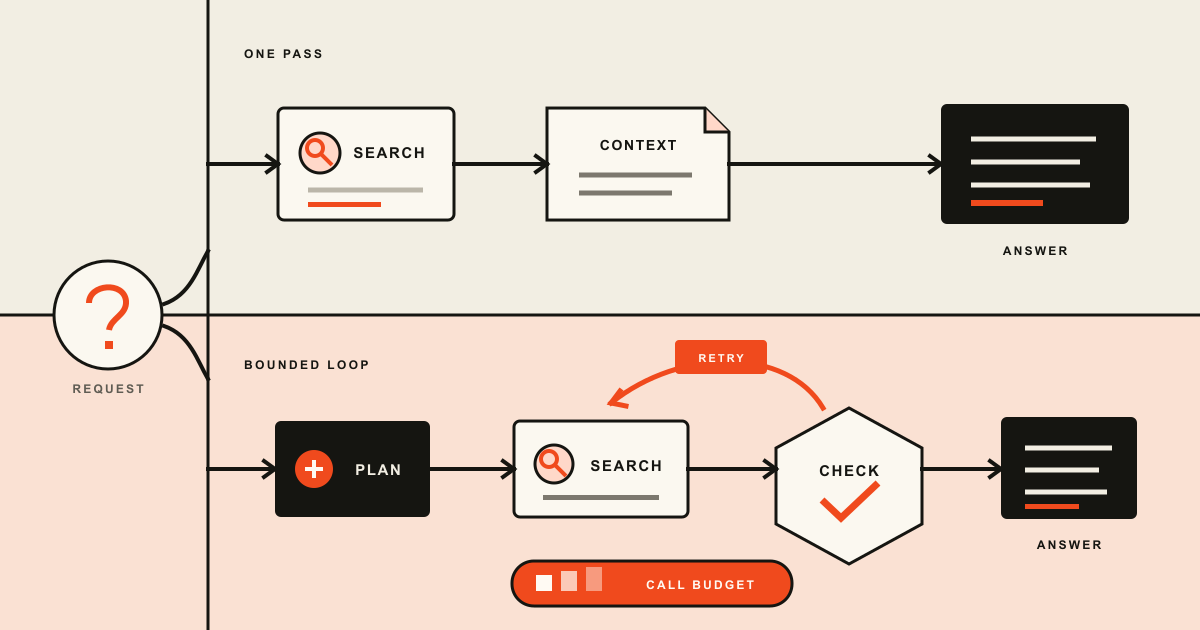 Agentic RAG
RAG vs agentic RAG compared on retrieval quality, latency, cost, reliability, and task fit, with a practical rule for choosing an architecture.
Open the field guideWhy Trace Brief exists
AI agents are no longer a single product category. The term now covers coding assistants, research systems, customer-service workflows, browser operators, and autonomous processes that connect models to real tools. That breadth creates confusion: a polished demo can look like a reliable system even when it has no durable state, meaningful evaluation, or safe recovery path.
Trace Brief is written for practitioners who need a clearer picture. We follow each system through its observable parts—model, instructions, context, tools, memory, control loop, and evaluation—then publish the clearest useful brief the evidence supports. Our goal is not to announce a winner. It is to help you make better technical and product decisions.
More about our methodEditorial map
Four lenses for understanding the systems behind the demos.
Agent loops, orchestration, memory, context engineering, and the trade-offs behind common framework choices.
Tool interfaces, MCP and A2A protocols, identity, permissions, observability, and durable execution.
Task success, trace inspection, adversarial tests, failure taxonomies, cost, latency, and human review.
Implementation patterns, honest comparisons, and lessons from systems that have moved beyond the prototype.
A better filter
The market moves faster than shared definitions. These three questions turn an impressive demo into an engineering conversation. We apply them throughout our reviews because they expose the difference between model capability and system reliability. They also make comparisons fairer: products can be evaluated against the same operational questions even when their interfaces, models, and preferred terminology differ.
Look past the conversational surface. Identify every tool, credential, data source, and external effect. Ask which actions are read-only, which are reversible, and which require a person to approve exact parameters. Autonomy without a visible boundary is not a capability; it is an unpriced risk.
A selected demo shows that a task can work once. A useful evaluation shows how often it works across ordinary cases, edge cases, tool failures, conflicting instructions, and changing data. Inspect complete task outcomes, not only eloquent final answers or model benchmark scores.
Production agents will encounter timeouts, stale context, denied permissions, and ambiguous goals. Dependable systems preserve state, avoid repeating side effects, stop within a budget, and explain what a human must decide. Recovery behavior is part of the product, not an implementation detail.
Editorial commitments
01 Primary sources first.
02 Corrections stay visible.
03 No pay-to-rank lists.