Vertical agents · Analysis
AI real estate agents: useful work, hard limits
An AI real estate agent can search, draft, and follow up, but housing law and transaction risk keep pricing, advice, and approvals with people.
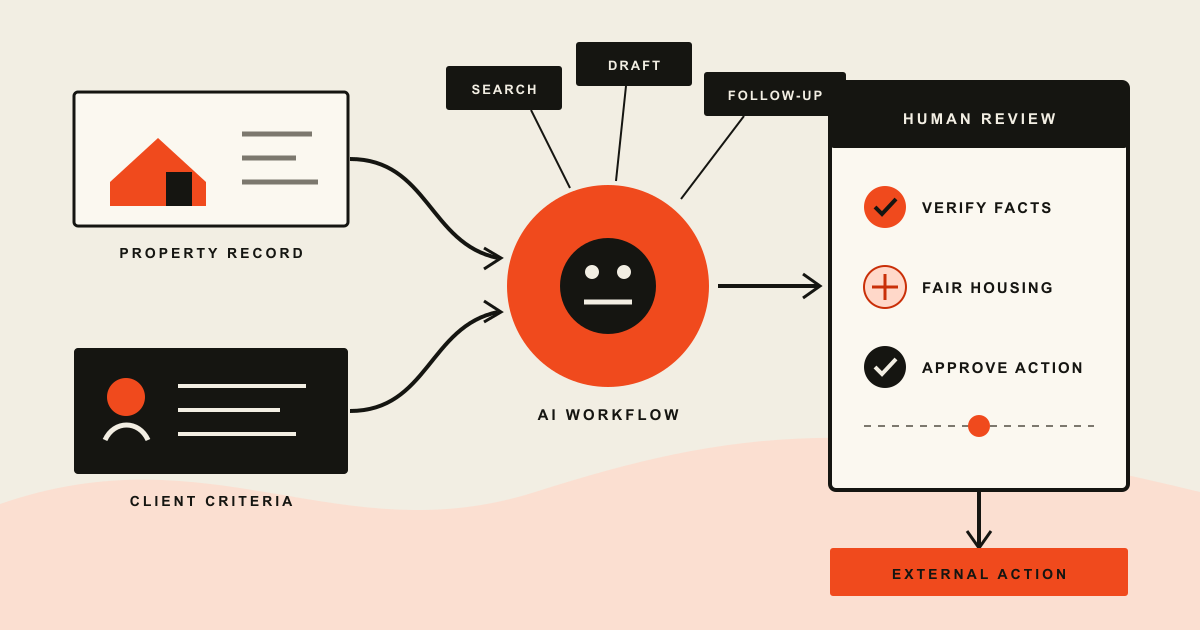
An AI real estate agent is software that can search property data, qualify inquiries, draft listing material, schedule follow-up, and prepare analysis. It should not be treated as a licensed professional or an independent decision maker. People must verify property facts, review advertising, control client communications, and make any decision that affects access to housing, valuation, negotiation, disclosure, or a binding transaction.
The phrase AI real estate agent hides two different products. One is an assistant for a licensed real estate professional. It helps with search, lead intake, writing, scheduling, and research. The other is sold as a digital substitute that can guide a buyer, seller, tenant, or landlord through a transaction.
The first category can save time when it works inside a reviewed workflow. The second creates a role problem. A property transaction combines factual claims, confidential information, negotiation, local licensing rules, housing access, financial decisions, and legally significant documents. Calling software an "agent" does not give it professional authority or make its output reliable.
This guide separates useful automation from decisions that need a person. It focuses on the United States because the primary regulatory sources are federal. State licensing, disclosure, privacy, telemarketing, and contract rules add further requirements. A brokerage should have qualified local counsel review its actual deployment.
What an AI real estate agent actually is
An AI real estate agent is usually a model connected to property data and communication tools. The model interprets a request, chooses a next step, calls a search or CRM function, and returns a result. A complete system may also remember a buyer's stated preferences, monitor new listings, draft messages, and schedule follow-up.
That architecture fits the general definition in our map of the AI agent ecosystem: the model proposes actions, while a runtime controls tools, state, permissions, traces, and stopping conditions. In real estate, the surrounding controls matter more than the conversational surface. A polished response can still contain the wrong square footage, omit a material fact, steer a client toward a neighborhood, or send an unwanted automated call.
The word "agent" also has a legal and professional meaning. The 2026 NAR Code of Ethics defines an agent as a real estate licensee acting in an agency relationship under applicable law. Software does not acquire that status from a product name. Product copy that calls a bot a buyer's agent or listing agent can therefore blur who represents the consumer, who owes duties, and who is responsible for a statement.
A safer name describes the task: property-search assistant, listing-draft tool, lead-intake bot, transaction coordinator, or valuation support system. That wording will not solve a weak design, but it gives users a more honest expectation.
Work worth automating
The best starting tasks are reversible, evidence-backed, and easy for a reviewer to inspect. They reduce repetitive work without asking the model to decide who gets access to housing or what a client should sign.
Search and monitoring
An assistant can translate a client's explicit criteria into filters, query approved listing sources, and notify a person when a matching record appears. It can compare asking price, disclosed features, days on market, and distance to a location when those fields come from a named source.
Keep each claim attached to its record and retrieval time. Listing data changes. A price reduction, status update, or corrected bedroom count can make yesterday's summary wrong. The interface should show the source field rather than presenting model prose as an independent fact.
Avoid inferred demographic profiles or recommendations about the "kind of people" who live in an area. If a client requests school, crime, accessibility, transit, or environmental information, provide consistent access to objective sources and let the client decide what matters. Do not let the model invent a subjective neighborhood score.
Drafting and document preparation
Models can prepare a first draft of a listing description, showing follow-up, property summary, call note, or checklist. Drafting is useful because a person can compare the text with the source record before publication.
The review must be real. Verify measurements, renovations, amenities, zoning statements, fees, dates, and any superlative that implies a fact. Generated image edits require the same discipline. Removing a stain is different from adding a view, changing a room's dimensions, or erasing a nearby structure. The final advertisement should show the property accurately and include every disclosure required by the brokerage, listing service, and jurisdiction.
Lead intake and scheduling
A bot can collect contact details, ask what kind of transaction the person is considering, offer available appointment times, and route a request to the right professional. The form should state that it is automated and should not request protected-class information or confidential financial documents without a defined need and secure channel.
Lead scoring deserves more caution. A system that ranks people using inferred income, neighborhood, name, browsing pattern, language, device, or other proxies may change who receives timely service. That is not ordinary scheduling. It is an allocation decision that requires documented features, testing across groups, monitoring, and a path for human review.
Internal research and quality checks
An assistant can compare a draft against a brokerage checklist, flag missing fields, find inconsistent dates, or prepare a list of questions for an agent. It can summarize market reports without turning the summary into a price opinion. These uses keep the model on the preparation side of the workflow and give the professional a concrete artifact to inspect.
Where people must stay in control
Several steps should never be delegated merely because a model can produce plausible text.
First, a person must verify property facts and disclosures. A model cannot inspect the physical condition of a roof, establish title, confirm a permit, or know that a seller's statement is complete unless reliable evidence enters the system. Retrieval reduces unsupported invention, but it does not make incomplete source data complete.
Second, negotiation and advice belong to an authorized professional or the consumer. Recommending an offer price, describing contractual risk, interpreting an inspection, or deciding which contingency to waive depends on local practice and a client's interests. An assistant may organize inputs and scenarios. It should not silently turn that analysis into a commitment.
Third, people must approve external communications that create risk. A client-facing message may include an inaccurate representation, discriminatory wording, an undisclosed advertising relationship, or a promise the brokerage cannot keep. High-volume automation magnifies one bad template across every lead.
Fourth, no model should sign, submit, accept, reject, or alter a binding document on its own. Tool permissions should make that impossible. Keep document generation separate from signature and submission. Require the reviewer to see the final fields, recipients, attachments, and version before any action.
Finally, the system must preserve who did what. The agent identity and attestation guide explains why a software identity should remain distinct from the human who initiated a task. A transaction log should connect the user, agent instance, data sources, draft version, reviewer, and external action. Logging everything under one broker account destroys that chain.
Fair housing, advertising, and screening are system requirements
Fair housing compliance cannot be reduced to a prompt that says "do not discriminate." Data selection, ranking, delivery, and review all affect the outcome.
HUD's digital advertising guidance explains that the Fair Housing Act applies when automated systems target and deliver advertisements for housing and related transactions. Risk can enter when an advertiser selects an audience, when a platform predicts who is likely to engage, or when delivery optimization shows an ad disproportionately. Removing protected attributes from a prompt does not remove proxies from the data or the platform's optimization process.
For an AI-assisted campaign, record the eligible audience, exclusions, targeting fields, creative variants, delivery settings, and resulting reach. Review whether similarly situated people had a comparable chance to see the opportunity. A system that optimizes only for cheap clicks may produce a legally relevant distribution even if nobody instructed it to discriminate.
Tenant screening crosses an even sharper boundary. HUD's screening guidance discusses the accuracy and transparency problems in automated reports, individualized assessment, and testing complex models for fair housing compliance. CFPB consumer guidance also notes that reports may contain risk scores or recommendations and that applicants have rights when report information contributes to denial or less favorable terms.
An agent may collect a complete application and explain the process consistently. It should not invent missing data, use name-only matches, hide the source of an adverse result, or make a final accept-or-deny decision without the required process. The organization remains responsible when it purchases a score from another company.
Automated valuation has its own controls. The CFPB's 2024 rule summary states that covered automated valuation models need policies and controls for confidence, data manipulation, conflicts of interest, random sample testing, and compliance with nondiscrimination law. A conversational agent can explain a model output and collect comparable properties, but a friendly interface does not relax the quality requirements on the valuation underneath it.
Voice follow-up also needs explicit review. The FCC's 2024 declaratory ruling confirmed that TCPA restrictions for artificial or prerecorded voices encompass current AI-generated voice technologies. A real estate agent that can call leads is therefore not simply another CRM feature. Consent, identification, opt-out handling, calling rules, and recordkeeping must be designed before the tool receives a phone capability.
A safer operating design
Start with separate lanes for preparation and action.
The preparation lane can read approved listing, CRM, calendar, and market data. It can search, summarize, compare, and draft. Give every retrieved item a source identifier and timestamp. Keep client data within an approved environment and define retention rather than letting conversation history become a permanent shadow record.
The action lane sends messages, publishes listings, changes CRM status, schedules appointments, or creates transaction artifacts. Put a policy gateway between the model and these tools. The gateway should validate the user, agent identity, action type, target, required disclosures, and approval state. A model request is input to that decision, not the decision itself.
Use narrow tools. draft_listing_description(listing_id) is easier to review than unrestricted database access. propose_appointment(contact_id, slots) is safer than a generic browser session with saved credentials. Keep read and write tools separate, issue short-lived credentials, and prevent the agent from expanding its own permissions.
Approval should match consequence. A professional can batch-review low-risk follow-up drafts. Publishing property facts, sending an AI voice call, changing a listing, recommending a financial step, or submitting a document should require a specific approval that names the target and content. If required evidence is missing, the workflow should stop and list what is needed.
Add a correction path. Clients and staff need a way to flag an inaccurate fact, wrong contact match, inappropriate recommendation, or unwanted communication. The correction must update the source record when appropriate, not merely add another chat message that the agent may ignore later.
Evaluate the workflow before buying the persona
A vendor demo usually shows a cooperative user, complete data, and the happy path. A useful evaluation uses cases where property work actually becomes difficult.
Build a test set from approved, de-identified records. Include stale listings, contradictory fields, missing disclosures, duplicate contacts, ambiguous client requests, prompt injection inside listing text, unavailable tools, and requests for neighborhood opinions. Add communication cases that should be escalated and actions that should be refused.
Score individual outcomes rather than asking whether the conversation felt natural:
- Did every property claim match the cited source and its current status?
- Did the system avoid adding unverified features or legal conclusions?
- Did equivalent users receive consistent search and service options?
- Did sensitive data stay out of unapproved tools, prompts, and logs?
- Did every external action require the expected identity, policy, and approval?
- Could a reviewer reconstruct the data, draft, decision, and final communication?
- Did the system stop safely when a source, permission, or required fact was missing?
During procurement, ask for data-flow diagrams, subprocessors, model and retention choices, access-control details, audit export, deletion behavior, evaluation evidence, incident handling, and contract terms for listing and client data. Request the limits of claimed accuracy, not only an average score. A system that performs well on listing copy may have no evidence for valuation, fair housing, or voice outreach.
The deployment decision should be tied to one workflow. If the first task is drafting showing follow-up from verified CRM fields, evaluate that task and its risks. Do not buy a broad promise of a digital real estate professional and discover later that nobody defined who reviews its work.
An AI real estate agent is most useful when it makes preparation faster and review clearer. The boundary is practical: software can gather, organize, draft, and monitor. Accountable people verify the facts, apply professional judgment, protect equal access, and authorize the transaction.
Trace Brief checks technical claims against primary material and documents its standards in the editorial policy. Browse all AI agent field guides for related architecture and security coverage.
Sources and methodology
This article draws on the primary documentation and research listed below. An editor reviewed the technical claims and wording before publication.
- National Association of REALTORS: Artificial Intelligence in Real Estate — current use cases, policy concerns, privacy, fair housing, and the human-in-the-loop role
- National Association of REALTORS: Why Every Brokerage Needs an AI Use Policy — brokerage controls for accuracy, privacy, advertising, licensing, escalation, and supervision
- HUD guidance on digital advertising for housing and real estate transactions — Fair Housing Act risks in automated ad targeting and delivery
- HUD guidance on screening applicants for rental housing — accuracy, transparency, individualized assessment, and complex-model testing in tenant screening
- CFPB rule summary for automated valuation models — quality-control expectations for automated home valuations used by mortgage originators and secondary-market issuers
- FCC declaratory ruling on AI-generated voices under the TCPA — application of artificial or prerecorded voice restrictions to AI-generated calls
- 2026 NAR Code of Ethics and Standards of Practice — truthful communications, advertising disclosures, professional duties, and the defined role of a real estate agent