Agent architecture · Analysis
The AI agent ecosystem in 2026: a practical map
Understand the AI agent ecosystem in 2026: models, memory, MCP, orchestration, evaluation, security, and production operations.
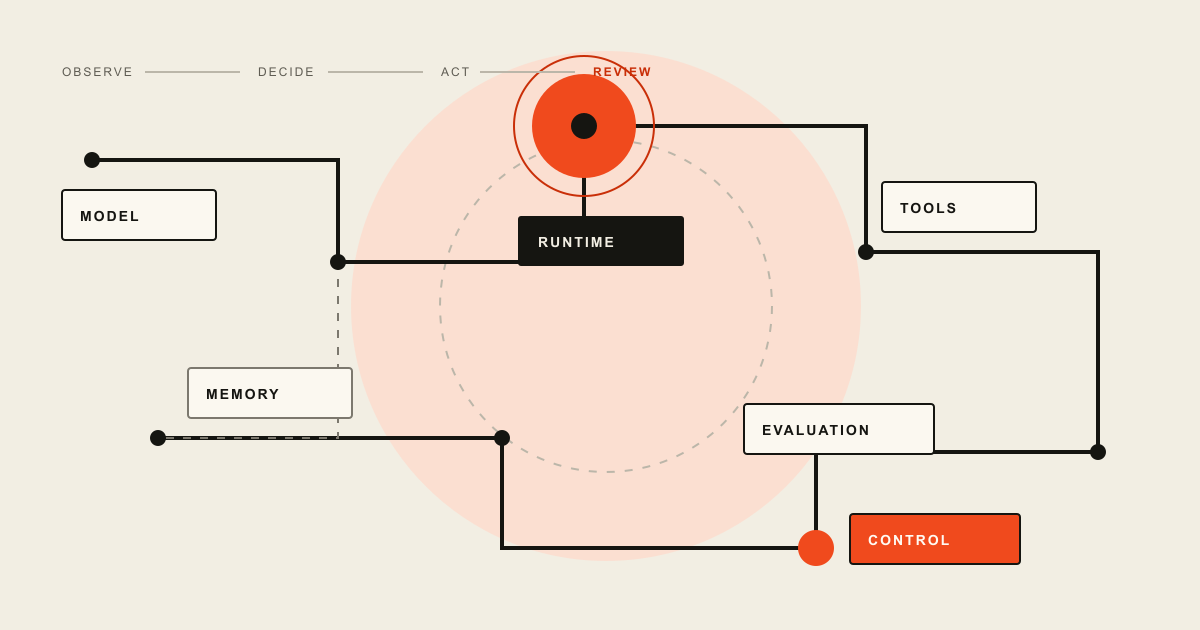
The AI agent ecosystem in 2026 is a software stack built around a model. The runtime manages the decision loop, tools perform actions, memory carries useful state, and protocols connect systems. Evaluations and guardrails check whether the result is safe and useful. A capable model cannot compensate for vague permissions, weak tools, or missing recovery controls.
Put a support bot with one retrieval tool beside a coding assistant that edits a repository and a procurement workflow that runs for hours. People call all three AI agents, even though their permissions, state, and failure modes have little in common.
A vendor chart tends to blur those differences, and it goes stale quickly. This guide maps the responsibilities that remain after product names change: inference, orchestration, tools, memory, evaluation, and control.
What counts as an AI agent?
An AI agent is software in which a model can choose the next step, use one or more tools, inspect the result, and continue until it reaches a stopping condition. Autonomy varies. Some systems request approval before every external action. Others work inside a constrained environment and escalate only when confidence is low or a permission is missing.
This is the difference between an agent and a conventional chat interface. Chat may stop after generating an answer. An agent takes part in a control loop:
- It receives a goal and relevant context.
- It chooses an action or produces an intermediate result.
- The runtime executes the action and records what happened.
- The model observes the result and decides whether to continue.
- A policy, budget, completion signal, or human ends the run.
The loop may finish after one turn or continue for hours. It can survive a process restart and pass work to specialists. Autonomy is a design choice bounded by permissions, time, cost, and risk.
Evaluate the whole system. A strong model attached to vague tools and unlimited permissions can be less useful than a smaller model inside a well-observed workflow with precise schemas and clear recovery behavior.
The six layers of the agent stack
Six layers account for most of the engineering work. A product may combine several behind one API, but each responsibility still has to live somewhere.
1. Models and inference
The model interprets instructions, produces structured output, selects tools, and synthesizes results. Benchmark quality is only one selection criterion. Teams also care about latency, cost, context length, modality, deployment requirements, and whether tool calls work reliably on their actual tasks.
Keep the model replaceable. Prompts, tool schemas, and evaluation cases should not be so entangled with one provider that an upgrade requires a rewrite. Still, "provider agnostic" is no excuse to ignore real differences. Models vary in how they follow constraints, recover from tool errors, and handle long contexts.
2. Agent runtimes and orchestration
The runtime surrounds the model loop. It assembles context, dispatches tool calls, handles retries, applies limits, streams events, and returns the result. Frameworks differ mainly in how much of that behavior they expose to developers.
A lightweight SDK fits a short workflow whose control flow belongs in ordinary code. Graph-oriented runtimes make more sense when execution branches, pauses for approval, resumes after failure, or persists across processes. In a multi-agent design, a central manager may call specialists as tools or hand control to another agent.
Integration counts are a weak way to choose a framework. Find the hardest state transition in the workflow instead. If a payment approval must survive a restart, durable state matters more than a large prompt-template catalog. A task that finishes in two tool calls probably does not need a complex graph.
3. Tools and environment
Tools are where model decisions become database reads, browser actions, code execution, tickets, or messages. Every tool therefore creates a trust boundary.
A tool should have a narrow scope and leave a useful record. Its name should describe the action, its input schema should reject ambiguous requests, and its output should distinguish success from partial failure. Permissions must reflect the current user. A refund_order tool with validated limits is safer than a generic execute_sql tool, even if both could produce the same database change.
Reusable instruction packages sit beside this tool layer without replacing it. A skill can teach an agent when to call a capability and how to validate the result, but it cannot create permissions or execution support that the runtime does not expose. Trace Brief's Agent Zero and SKILL.md guide explains that boundary and the portable package structure in detail.
Execution environments also matter. Code-running agents need isolation, resource limits, network policy, and an explicit filesystem boundary. Browser agents need protection against hostile page content and clear confirmation before consequential actions. The runtime should treat tool output as untrusted data, not as new instructions.
4. Context and memory
Context is what the model can see for the current decision. Memory decides what should persist and how it returns later. The terms describe different parts of the system.
Short-term memory may be the conversation and recent tool results. Long-term memory can include user preferences, approved facts, summaries, or domain records stored outside the model context. Retrieval systems select relevant items; compaction keeps a growing run within a usable budget.
Maximizing retention is the wrong goal. The system needs to decide what is safe and useful to recall. Stored model conclusions can be wrong, and personal data may have retention constraints. Record provenance, separate user-provided facts from model-generated summaries, and allow stored information to expire or be corrected.
5. Evaluation and observability
An uptime graph can show that the service responded. It cannot show whether an agent made a sensible sequence of decisions. For that, teams need traces of model turns, tool arguments and results, handoffs, guardrail outcomes, latency, token usage, and human interventions.
Score the outcomes that matter for the task. A customer-service agent might be measured on resolution accuracy, policy compliance, escalation quality, and cost. A coding agent may need tests, static analysis, review acceptance, and a check that it touched only the intended files. One aggregate "quality" number can hide the failure that matters.
Build an evaluation set from real tasks and known incidents. Run it when prompts, tools, models, or orchestration logic change. Production traces should feed new edge cases back into that set after sensitive information has been handled appropriately.
6. Identity, policy, and human control
Give an agent an identity distinct from the model provider and, in most cases, from the person who started the run. That identity determines which resources it can access, which actions require approval, and how the audit log attributes changes.
Apply least privilege at the tool layer and use short-lived credentials when possible. Keep read and write capabilities separate. Irreversible, high-value, or public actions need human confirmation. The approval screen should name the action, target, and parameters. A generic "Allow?" dialog gives the reviewer responsibility without enough information to make a decision.
The NIST AI Risk Management Framework organizes risk work around governing, mapping, measuring, and managing. Agent teams need those activities during design and operation because tools can turn a model error into an external action.
How MCP and A2A connect the stack
Two protocol families cover different connection problems.
Model Context Protocol (MCP) standardizes how an AI application connects to servers that expose tools, resources, and prompts. Its host-client-server architecture keeps the host responsible for orchestration and creates a dedicated client connection for each server. MCP does not decide how an agent reasons; it gives applications a consistent way to discover and invoke capabilities.
A team can expose a database schema as a resource and a constrained query function as a tool without building a custom integration for every agent host. The standard interface does not remove the need for security review. A remotely discovered tool still needs authentication, authorization, input validation, and careful treatment of returned content.
Agent2Agent (A2A) addresses communication between independent agent systems. The specification defines how agents advertise capabilities, exchange messages, manage tasks, and return artifacts. In broad terms, MCP connects an agent application to context and tools, while A2A helps one agent system collaborate with another.
The protocols solve different parts of the connection problem and can be used together. Real deployments still need agreement on identity, authorization, data semantics, error handling, and service-level expectations. A common envelope cannot guarantee that two agents interpret a business concept the same way.
What changes in production
Prototype demos usually show the successful path. Production systems also need an answer for timeouts, partial data, repeated actions, stale approvals, and records that change while the agent is planning.
The runtime needs idempotency keys, time and cost budgets, cancellation, retry policy, checkpoints, and a dead-letter or escalation path. Without those controls, retrying a failed run can repeat a payment, overwrite newer data, or leave work in an ambiguous state.
Prompt wording cannot carry the security model. "Do not reveal secrets" is an instruction, not a permission system. Secrets should be unavailable unless a specific tool requires them, and that tool should enforce the permitted operation. Text found in documents, web pages, emails, or tool output must not silently override system policy. Sensitive trace data also needs redaction and retention controls.
Human oversight works best when it is designed around risk tiers:
- Low-risk, reversible reads can run automatically and remain fully logged.
- Bounded writes can run automatically when validation passes and rollback is available.
- Financial, destructive, legal, or public actions require explicit approval.
- Ambiguous or policy-conflicting tasks stop safely and explain what is needed.
Risk tiers keep people focused on consequential decisions. If every read requires the same confirmation as a payment, reviewers will learn to approve prompts without reading them.
How to choose an agent stack
Pick one workflow before evaluating platforms. Write down its input, desired outcome, available evidence, permitted actions, and accountable owner. Implement the simplest deterministic version that can do the job, then add model-driven decisions where fixed rules cannot handle the variation.
Use the following questions to evaluate architecture and vendors:
- Can we see and constrain every external action?
- Can a run pause, resume, and recover without repeating side effects?
- Can the final result point to the tool outputs or sources behind it?
- Can we replay representative tasks after a system change?
- Does the agent act with scoped credentials and an auditable identity?
- Which interfaces are standard, and which behaviors are proprietary?
- What do complete tasks cost, including retries, and how long do they take?
- What happens when confidence is low, a tool fails, or the budget runs out?
Run a small evaluation before committing to a framework. Include ordinary cases, malformed inputs, unavailable tools, permission failures, conflicting instructions, and tasks that should be refused. Inspect the complete traces rather than grading only the final prose.
Model upgrades arrive faster than most teams can rework permissions, traces, or recovery logic. Those components deserve more attention than model branding. If a model makes a poor choice, the tools should limit what it can change. Checkpoints should stop a retry from repeating the action, and the trace should give a reviewer enough evidence to reconstruct the run.
For more implementation-focused coverage as the archive grows, browse all Trace Brief field guides and review the standards we use for technical claims.
Sources and methodology
This article draws on the primary documentation and research listed below. An editor reviewed the technical claims and wording before publication.
- OpenAI Agents SDK documentation — agent loops, tools, handoffs, guardrails, sessions, and tracing
- Model Context Protocol architecture — official MCP participants, primitives, and transport model
- A2A Protocol specification — agent discovery, tasks, messages, artifacts, and interoperability
- LangGraph overview — durable execution, persistence, streaming, and human-in-the-loop orchestration
- NIST AI Risk Management Framework — governance, mapping, measurement, and management of AI risk