Agent market · Analysis
AI agent startup funding in 2026: a source-checked snapshot
Track AI agent startup funding 2026 with primary-source checks that separate round size, total funding, valuation, and product focus.
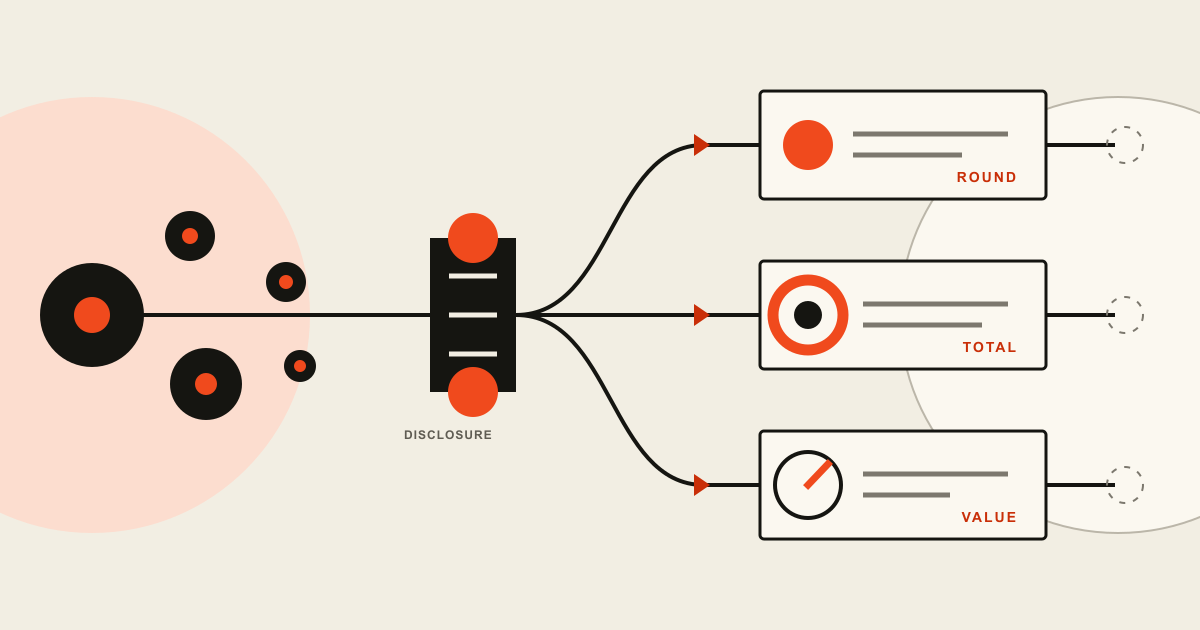
In selected company announcements reviewed through August 2, 2026, Decagon disclosed a $250 million Series D, Prime Intellect a $130 million round, Resolve AI a $125 million Series A, LiveKit a $100 million Series C, and Mastra a $22 million Series A. Bespoke Labs announced $40 million across seed and Series A financings, while AIsa disclosed $6.5 million in total funding but did not isolate its new seed amount. This is a source-checked snapshot, not a complete market total.
A funding headline looks simple until two companies use the same number to mean different things. One announces a $100 million Series C. Another says it has raised $40 million across two financings. A third reports $6.5 million in total funding, including a seed round whose individual size is not stated. Flatten those figures into one "round size" column and the tracker becomes precise-looking fiction.
This report keeps the fields separate. It covers seven public announcements from AI agent startups and infrastructure companies between January 1 and August 2, 2026. Each entry links to the company announcement or an issuer-supplied release. The selection spans application agents, runtimes, training systems, evaluation environments, and transaction infrastructure. It does not attempt to count every deal in the category.
The comparison therefore starts with what each company actually disclosed, which part of the AI agent stack it sells, and what remains unknown after the announcement.
Scope and method
An "AI agent startup" is a slippery category. For this snapshot, a company qualifies when its own product description centers on software that can take actions, use tools, or support the operation and improvement of those systems. A general model lab does not enter the list merely because its models can power agents. Neither does an ordinary SaaS company that adds "agentic" to one launch page.
An entry also needs issuer material that states the financing language and describes how the product relates to agents. News reports helped locate candidates, but they did not supply the table fields. The review uses the announcement date, which may differ from the legal closing date. Amounts remain in US dollars as disclosed. The table does not convert a cumulative total into a current round, infer an undisclosed valuation, or add prior rounds from databases that may use different definitions.
Four fields need clean boundaries. Disclosed financing is the amount the announcement assigns to the named round or group of rounds. Total funding is the cumulative amount stated by the company, sometimes qualified with words such as "more than." Valuation is the company value stated in the announcement. If the source does not say whether it is pre-money or post-money, this report does not guess. Product layer is an editorial classification based on what the company says it sells, not an investment category supplied by the company.
Company posts are primary evidence for what an issuer disclosed. They are also marketing documents. Product claims, customer results, and plans should be read as company statements unless independently verified. The Trace Brief editorial policy explains why a direct source can be authoritative about an announcement without being neutral about the business.
Selected AI agent funding announced in 2026
| Company | Announcement | Disclosed financing | Total funding stated | Valuation stated | Product layer |
|---|---|---|---|---|---|
| LiveKit | Jan. 22 | $100M Series C | Not stated | $1B, basis not stated | Voice agent runtime |
| Decagon | Jan. 27 | $250M Series D | Not stated | $4.5B, basis not stated | Customer service agents |
| Mastra | Apr. 9 | $22M Series A | $35M | Not stated | Agent framework and platform |
| Bespoke Labs | Jul. 6 | $40M across seed and Series A | Not stated as a separate total | Not stated | Training and evaluation environments |
| AIsa | Jul. 7 | New seed amount not isolated | $6.5M, including the seed | Not stated | Agent transactions and payments |
| Prime Intellect | Jul. 8 | $130M Series A | More than $150M | Not stated | Training, inference, and agent infrastructure |
| Resolve AI | Jul. 17 | $125M Series A | More than $150M | $1B, basis not stated | Production engineering agents |
This table should not be summed as seven equivalent 2026 rounds. Five announcements assign an amount to one named financing: LiveKit, Decagon, Mastra, Prime Intellect, and Resolve AI. Bespoke Labs uses $40 million for seed and Series A financings together. AIsa uses $6.5 million for total funding to date, which includes a new seed but does not identify that seed's standalone amount.
Adding the columns would mix current-period capital with earlier financing and present the result as new money raised in 2026. The source language does not support that claim.
Large rounds reached application agents
Two of the largest clearly identified rounds in this selection went to companies selling agents for specific operational work rather than a general development toolkit.
Decagon: $250 million Series D
On January 27, Decagon announced a $250 million Series D led by new investors Coatue Management and Index Ventures. The company said the financing tripled its valuation to $4.5 billion in less than six months. It did not specify whether that figure was pre-money or post-money, and the announcement did not state cumulative funding.
Decagon describes its product as an AI concierge for enterprise customer experience. That puts the company in the application layer: the agent handles conversations and actions around support or service workflows. The announcement named more than 100 new enterprise customers during the prior fiscal year, but it did not publish audited revenue, retention, or unit economics. The financing and valuation are disclosed facts. The operating strength implied by them still requires separate evidence.
Resolve AI: $125 million Series A
Resolve AI announced a $125 million Series A on July 17. Lightspeed Venture Partners led the round, with existing investors participating. The company called it a "non-blended" Series A, stated a $1 billion valuation, and said total funding exceeded $150 million.
The wording makes all three figures usable without conflating them: $125 million for the current Series A, more than $150 million cumulatively, and $1 billion for the valuation. The announcement does not label the valuation pre-money or post-money.
Resolve builds agents for production engineering and site reliability work. Its post says the agents investigate incidents across code, telemetry, infrastructure, and system changes. That work has an unusually sharp permission boundary because an agent can move from reading an alert to touching production systems. Funding diligence for this category should include the separate runtime identity, scoped authorization, and audit trail described in our agent identity and attestation guide.
The two application rounds do not prove that vertical agents receive more capital than infrastructure companies. Seven selected announcements cannot support a market-share conclusion. They do show that investors funded narrowly described operational outcomes at nine-figure levels during the review period.
Capital also covered the supporting stack
Five announcements concern systems underneath or around the end-user agent. Their products differ enough that grouping them as one "agent platform" category would hide the actual bets.
LiveKit: $100 million Series C
LiveKit announced a $100 million Series C on January 22, led by Index Ventures. The company stated a $1 billion valuation but did not provide cumulative funding or specify the valuation basis.
LiveKit began as real-time audio and video infrastructure. Its current product includes a framework and cloud platform for voice, video, and physical AI agents. This is runtime infrastructure rather than a customer service agent in its own right. The financing therefore backs a communication and execution layer that other companies use to build voice-driven products.
Mastra: $22 million Series A
On April 9, Mastra announced a $22 million Series A led by Spark Capital and said the round brought total funding to $35 million. It did not disclose a valuation.
Mastra combines an open source TypeScript agent framework with a platform for deployment, traces, evaluations, memory, and workflows. The announcement is unusually clear on round size and cumulative capital. Those numbers can occupy separate fields without further interpretation.
Bespoke Labs: $40 million across two financings
Bespoke Labs announced $40 million on July 6, but its wording matters. The company described seed and Series A financing rounds. It separately identified an $8.25 million seed led by 8VC and said Wing VC led the Series A. It did not explicitly state the Series A amount in the article body.
Subtracting $8.25 million from the $40 million headline would produce $31.75 million, but that would be an editorial calculation rather than a disclosed Series A figure. The safe record is $40 million across the two financings, with an $8.25 million seed component and no separately stated Series A amount.
Bespoke builds data, reinforcement learning environments, sandboxes, and optimization systems for training and evaluating agents. Its round sits in the reliability and post-training layer, not the application layer.
AIsa: $6.5 million total funding, seed amount undisclosed
The July 7 AIsa release said the company had raised $6.5 million in total funding to date, including a new seed round co-led by Alibaba and Tribe Capital. It did not say how much of the $6.5 million belonged to the seed.
AIsa provides a programmable layer through which agents can discover and pay for models, APIs, data, compute, and software services. The company also describes spending controls and audit trails. That makes it transaction infrastructure for agents. Recording $6.5 million as the 2026 seed would overstate what the source says. The number belongs in the total-funding field.
Prime Intellect: $130 million Series A
Prime Intellect announced a $130 million Series A on July 8, led by Radical Ventures, and said total funding had risen above $150 million. The company announcement did not disclose a valuation.
Prime Intellect sells compute, reinforcement learning systems, environments, sandboxes, evaluations, inference, and deployment infrastructure. Its announcement connects the financing to a stack for training and improving agents in production. The label "Series A" alone says little about the company's maturity or capital intensity. Here, the disclosed round is larger than several later-stage rounds elsewhere in software.
How to read an AI agent funding announcement
The first pass should copy the source language before normalizing anything. A small record with explicit nulls is more useful than a polished row filled with assumptions.
- Record the announcement date and link. Do not silently substitute a database's estimated close date.
- Copy the named stage and the amount assigned to it. If one headline combines several rounds, retain the combined label.
- Put cumulative capital in a separate total-funding field. Preserve qualifiers such as "more than."
- Record valuation only when the source states one. Add pre-money or post-money only when the source supplies that basis.
- Separate equity financing from debt, grants, secondary share sales, and acquisition prices. This snapshot includes only the financing described in each cited announcement.
- Capture the lead investor and the company's stated use of proceeds, but do not treat either as proof that the plan has been executed.
- Classify the product from concrete functions. "Agent infrastructure" can mean a runtime, an evaluation environment, a payment rail, or a model training system.
Round labels are not a common unit of company development. Resolve AI and Prime Intellect both announced nine-figure Series A rounds. Mastra's Series A was $22 million. The label helps trace a company's financing history, but it does not make the businesses directly comparable.
Valuation requires similar restraint. A $1 billion post-money valuation after a $100 million investment is not the same calculation as a $1 billion pre-money valuation before that investment. LiveKit and Resolve AI each stated a $1 billion valuation without identifying the basis in the cited announcement. The appropriate entry is "basis not stated," not a guessed post-money figure.
What these selected rounds signal
The sample covers more than companies that ship a visible agent to an end user. It includes the systems used to build, train, run, evaluate, and pay for agents. That breadth is the clearest observation the selection supports.
Application companies attracted large disclosed rounds where the agent owns a legible business task. Decagon focuses on customer interactions. Resolve focuses on production engineering. Their announcements describe the outcome first and the model stack second.
Infrastructure companies are being funded at several layers. LiveKit handles real-time interaction. Mastra provides a framework and operational platform. Bespoke Labs focuses on training environments and reliability. Prime Intellect spans training and inference. AIsa handles resource access and transactions. These are not interchangeable products, even though each uses the language of agents.
The disclosures also reveal how little a headline standardizes. Five companies supplied a clean current-round amount. Two required a different record shape. That is a warning for any tracker assembled by scraping headlines alone. A database should allow an unknown round amount, a qualified cumulative total, and an unspecified valuation basis without forcing a number into the wrong column.
Several announcements tie proceeds to evaluation, controls, infrastructure, or reliability rather than model access alone. Those spending plans match the responsibilities mapped in the AI agent ecosystem guide: production behavior depends on tools, state, permissions, traces, and recovery systems around the model. The selected financings show companies selling those surrounding layers. They do not show which approach will endure.
What funding cannot prove
A financing announcement confirms that a transaction was disclosed under certain terms. It does not establish product quality, revenue quality, safety, or durable demand.
The company may publish customer names without contract values. A usage figure may count registered accounts rather than active paying customers. Annualized revenue is not audited annual revenue. A valuation is a negotiated price for a financing event, not a cash balance and not a forecast of an exit price.
The data also has selection bias. Companies announce rounds when disclosure helps them recruit, sell, or raise visibility. Quiet extensions, debt facilities, internal restructurings, and undisclosed investments may never appear on a company blog. Geography and language affect discovery. A source-checked list can still be incomplete.
For that reason, this page does not rank the "top" AI agent startups or claim a total for 2026. It records a bounded set of announcements whose amounts and product scope can be traced to issuer material. Future updates should append newly verified records, preserve the original announcement wording, and change a field only when a source supports the correction.
Readers comparing a startup should take the same approach. Start with the financing record, then inspect the product boundary, customer evidence, security controls, and operating economics separately. Money can buy time to solve those problems. It cannot show that they have already been solved.
Sources and methodology
This article draws on the primary documentation and research listed below. An editor reviewed the technical claims and wording before publication.
- Decagon Series D announcement — $250 million Series D, $4.5 billion valuation, investors, product focus, and January 27 announcement date
- LiveKit Series C announcement — $100 million Series C, $1 billion valuation, lead investor, and voice agent infrastructure scope
- Mastra Series A announcement — $22 million Series A, $35 million total funding, investor, and agent framework and platform scope
- Bespoke Labs financing announcement — $40 million headline across seed and Series A financings, separately disclosed $8.25 million seed, investors, and product scope
- AIsa funding announcement — $6.5 million total funding to date including a new seed round, investors, and agent transaction network scope
- Prime Intellect Series A announcement — $130 million Series A, more than $150 million total funding, investors, and agent training infrastructure scope
- Resolve AI Series A announcement — $125 million Series A, more than $150 million total funding, $1 billion valuation, investors, and production agent scope