Agent interoperability · Analysis
A2A vs MCP: responsibilities, messages, and trust boundaries
A2A vs MCP compared by protocol role, message model, task lifecycle, discovery, and trust boundary, with a practical guide to using one or both.
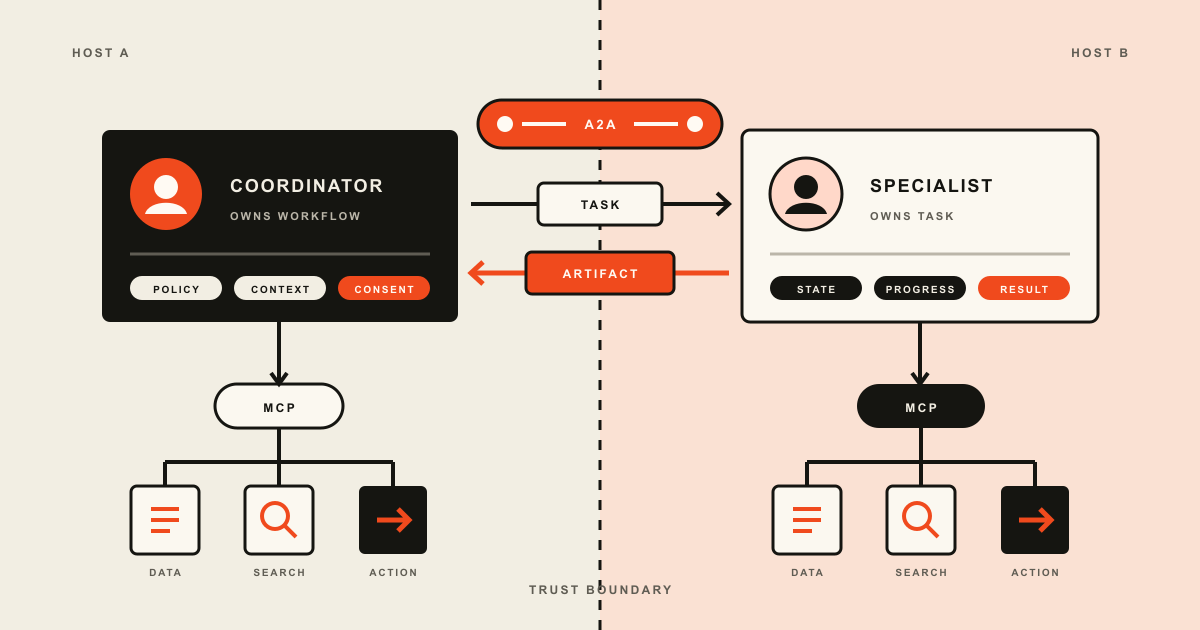
MCP connects an AI host to servers that expose tools, resources, prompts, and related utilities. The host keeps orchestration, context aggregation, security policy, and user consent. A2A connects independent agent services that advertise skills through Agent Cards and exchange messages, tasks, status updates, and artifacts. Use MCP when one application owns the workflow and needs external capabilities. Use A2A when a remote agent owns a stateful unit of work. Use both when one agent delegates to another through A2A and either agent reaches its tools through MCP.
A2A vs MCP is a choice between protocol roles, not a contest for one universal agent standard. The Model Context Protocol (MCP) gives an AI application a common way to reach tools and context. The Agent2Agent Protocol (A2A) gives independent agent services a common way to discover one another, exchange work, and track what happens next.
The distinction sounds tidy until a tool wraps an agent, an agent offers a single predictable operation, or a long-running MCP call starts to look like an A2A task. Current specifications support more overlap than many comparison charts admit. MCP has bidirectional client and server features plus experimental Tasks. A2A 1.0 has multiple protocol bindings and can return a direct message for simple interactions.
Responsibility provides a more stable dividing line. With MCP, the host application remains the coordinator and consumes capabilities from servers. With A2A, a client asks a remote agent to take responsibility for a unit of work through an explicit agent-facing contract. That handoff changes the message model, the state that crosses the boundary, and the evidence needed to trust the result.
The two protocol roles
The current MCP architecture specification defines a client-host-server system. The host is the AI application. It creates one MCP client for each server, aggregates context, coordinates model use, enforces security policies, and handles user authorization decisions. Each MCP client maintains an isolated stateful session with one MCP server.
MCP servers expose focused capabilities. The core server primitives are prompts, resources, and tools. Prompts are user controlled, resources are application controlled, and tools are model controlled in the specification's control hierarchy. Servers can also request client-side sampling or elicitation when the negotiated capabilities allow it. MCP is therefore more than one-way function calling, but the host still owns the larger interaction.
The current A2A 1.0 specification defines a client agent and an A2A server, also called a remote agent. The client sends work on behalf of a user or another system. The remote agent exposes its identity, supported interfaces, capabilities, security requirements, and skills through an Agent Card. It then processes messages, owns any tasks it creates, reports state, and returns artifacts.
A2A treats the remote agent as an opaque service. The caller does not need access to the remote agent's model, memory, prompt, or tool graph. That opacity is deliberate. Two organizations can collaborate through the protocol without agreeing on an internal framework.
The official A2A documentation describes the protocols as complementary: MCP connects an agent to tools, APIs, and resources, while A2A connects independent agents. This is a useful default, but it is not an implementation law. An MCP tool can wrap an agent. An A2A server can expose a narrow deterministic skill. The right boundary depends on who owns the work after the call.
If the caller owns the workflow and invokes a capability, start with MCP. If the remote service accepts a goal and owns a stateful work lifecycle, start with A2A.
A2A vs MCP side by side
| Dimension | MCP | A2A |
|---|---|---|
| Primary relationship | AI host and capability server | Client agent and remote agent service |
| Main responsibility | Make tools and context available inside a host-owned workflow | Delegate and track work across an agent boundary |
| Discovery surface | Connection initialization, capability negotiation, and primitive listing | Agent Card with identity, interfaces, capabilities, security schemes, and skills |
| Core application objects | Prompts, resources, tools, sampling, elicitation, notifications | Messages, tasks, task states, parts, artifacts, Agent Cards |
| State owner | Host owns conversation and orchestration; each client owns one server session | Remote agent owns tasks it creates; contextId groups related interactions |
| Typical result | Resource content, prompt data, tool result, or client-side response | Direct message or task updates ending in one or more artifacts |
| Long-running work | Experimental task augmentation, progress, polling, and deferred result retrieval | Core task lifecycle with streaming, polling, subscription, and push options |
| Transport shape | Stdio for local processes or Streamable HTTP for remote servers | Protocol-neutral model with JSON-RPC, gRPC, and HTTP+JSON bindings in 1.0 |
| Security center | Host policy plus authorization to each remote MCP server | Authentication and authorization between independently operated agent services |
| Best fit | One application composing tools and data sources | Cross-service or cross-organization agent collaboration |
Neither protocol chooses the model, plans a workflow, evaluates an answer, or grants a model unrestricted autonomy. They standardize communication surfaces. The application still decides when to call, what authority to attach, how to validate a result, and whether an action requires human approval.
This separation helps place both protocols in the wider AI agent ecosystem. MCP and A2A sit between runtimes and external systems. They do not replace orchestration frameworks, evaluation, identity infrastructure, or domain APIs.
Requests, messages, tasks, and artifacts
MCP uses JSON-RPC 2.0 for its data layer. A client initializes a session, negotiates capabilities, lists the primitives a server exposes, and makes operations such as tools/call or resources/read. The result returns to the host, which decides how to use it in the conversation or workflow. Notifications carry changes and progress without requiring a response.
The server does not receive the host's entire conversation by default. MCP's design principles say a server should receive only the context it needs and should not see other servers. The host controls cross-server interaction. This makes MCP a good fit for a coordinator that calls a database tool, a source-code tool, and a ticketing tool while keeping the overall plan and user conversation in one place.
A2A defines a more explicit collaboration vocabulary. A Message is one communication turn with a sender role and one or more Part objects. Parts can contain text, file references, or structured data. A Task is a server-created, stateful unit of work with its own identifier and lifecycle. An Artifact is an output produced by a task, also composed of parts.
In A2A 1.0, messages start or continue interactions. A remote agent can use a message to request clarification or report task status. The specification says task outputs should be delivered as artifacts rather than smuggled into status messages. This gives clients a stable distinction between conversation, execution state, and output data.
Two identifiers serve different scopes. A contextId groups messages and tasks that belong to one conversational context. A taskId identifies one unit of work and is generated by the server that owns it. A message may refer to the context, the task, or both. The remote agent can pause a task for more input or authorization, stream status and artifact updates, accept cancellation, and expose the result after the original connection ends.
That vocabulary carries engineering cost. The client needs to store identifiers, handle state transitions, deduplicate messages, reconnect to streams, validate artifacts, and decide what to do with partial or failed work. If an integration only needs lookup_customer(customer_id) and a structured response, the richer contract may add state without adding useful behavior.
Why tasks do not make the protocols equivalent
Older comparisons often say MCP is request-response while A2A has tasks. That statement no longer matches the current MCP specification. MCP Tasks were introduced in revision 2025-11-25 and remain experimental. A requestor can augment a supported operation with a durable task, poll its state, supply input, cancel it, and retrieve the result later.
The two task abstractions solve related timing problems but sit at different semantic levels.
| Question | MCP Task | A2A Task |
|---|---|---|
| What does it represent? | The execution state of an underlying MCP request | A unit of work owned by a remote agent |
| How is it created? | The requestor asks to augment a supported request; the receiver accepts it | The remote agent creates a task in response to a message |
| What is the final output? | The result the wrapped operation would have returned | One or more artifacts plus task history and status |
| Who coordinates related work? | The MCP requestor or host | The A2A client and remote agent through context and task semantics |
| Stability | Experimental in the current stable MCP revision | Foundational to released A2A 1.0 |
MCP Tasks make expensive tool calls, batch jobs, and deferred results easier to handle. They do not turn every MCP server into a peer agent, provide an Agent Card, define high-level skills, or create an agent-to-agent conversation model. Conversely, A2A does not standardize how the remote agent reaches its database or invokes its internal tools. An A2A task can depend on several MCP calls hidden behind the remote agent boundary.
A July 2026 implementation study compared MCP and A2A versions of one constrained software-engineering collaboration. The A2A implementation had 1,898 source lines versus 1,255 for MCP, 10 coordination primitives versus 4, and 6 coordination stages per interaction versus 2. The authors found that MCP supported the narrow coordination pattern with less machinery, while A2A expressed stateful multi-turn coordination more directly.
Those numbers are not a general benchmark. The paper calls itself an experience report, covers one task, and warns against broad conclusions. Its MCP discussion also treats task lifecycle as application logic, while the current stable MCP revision has experimental Tasks. The study is most useful as a reminder about where coordination code goes. A protocol with more collaboration semantics can move work out of application code, but clients must implement and operate those semantics.
Trust and authorization boundaries
Authentication proves who is on a connection. It does not prove that a tool is safe, an agent's skill description is accurate, or an artifact is correct. Both protocols depend on application policy beyond the wire format.
In MCP, the host is the central trust anchor for the user experience. It chooses servers, creates isolated clients, decides what context each server receives, manages user consent, and combines results. For remote HTTP servers, the MCP authorization specification treats the server as an OAuth protected resource. Clients must use resource indicators so a token targets the intended MCP server. An MCP server must not pass the client's token through to an upstream API.
Authorization is optional at the MCP protocol level because local stdio and remote HTTP deployments have different needs. The specification says stdio implementations should obtain credentials from their environment rather than use the HTTP authorization flow. That does not make a local server trusted. Launch configuration, filesystem permissions, environment variables, subprocess isolation, and the server package itself become part of the host's security boundary.
In A2A, the boundary sits between independently operated services. The Agent Card declares endpoints, protocol versions, capabilities, skills, and supported security schemes. A client may obtain a public card from /.well-known/agent-card.json, a registry, or direct configuration. The card helps discovery, but discovery is not endorsement. The client still needs a policy for approved providers, domains, signatures, protocol versions, and skills.
A2A uses standard web security mechanisms. Production connections require encrypted transport. Credentials travel through the chosen transport mechanism, not inside A2A message payloads. The remote server authenticates the caller and applies its own authorization rules to operations, skills, and data. The specification supports signed Agent Cards and authenticated extended cards, but clients must verify signatures and control access to protected card details.
The hardest case is delegated authority. A user may authorize Agent A, which asks Agent B, which calls an MCP server that reaches a business system. Neither protocol by itself proves that every downstream action remains within the user's intent. The design needs explicit principal and delegation records, audience-restricted credentials, scope reduction at each hop, approval for sensitive actions, and a trace that connects the final side effect to the initiating request. Trace Brief's agent identity and attestation guide covers that broader identity problem.
Treat remote outputs according to their origin. MCP tool results and A2A messages or artifacts can contain prompt injection, malformed files, stale data, or claims unsupported by evidence. Validate schemas, scan active content, preserve provenance, and keep an untrusted remote result from silently becoming a privileged instruction.
Choose MCP, A2A, both, or neither
Use MCP when one host owns the user interaction and workflow. The host may need a portable way to discover tools, read resources, request prompts, or let a server ask for elicitation. MCP also fits a remote specialist that behaves like a bounded function: the caller supplies typed arguments and receives a result without negotiating an ongoing collaboration.
Use A2A when the remote system should remain an independent agent service. Good signals include high-level skill discovery, work that continues after the initiating request, multiple messages within one context, clarification or authorization pauses, incremental artifacts, and task recovery after disconnection. A2A gives those interactions shared protocol objects rather than requiring every pair of systems to invent them.
Use both when the architecture has two distinct layers. A coordinator delegates a goal to a remote specialist through A2A. The specialist owns that task, reports progress, and returns artifacts. Inside its own boundary, the specialist uses MCP clients to reach approved data and tools. The coordinator may use its own MCP servers as well.
Use neither when a normal API is clearer. A stable service with a fixed caller, a fixed schema, and no model-facing discovery may be better as REST, gRPC, an event stream, or a queue. Protocol adoption should remove integration work or create a needed interoperability boundary. It should not rename an ordinary service call.
| Situation | Starting choice |
|---|---|
| Desktop assistant reading files and calling local developer tools | MCP |
| One enterprise copilot calling approved internal systems | MCP |
| Remote research agent that accepts a goal and returns a report later | A2A |
| Two vendors' agents negotiating scope and exchanging artifacts | A2A |
| Coordinator delegates to specialists that each use private tools | A2A between agents, MCP inside each agent |
| Internal function with one caller and a stable contract | Direct API unless protocol portability has a measured benefit |
The physical deployment does not decide the protocol. A remote MCP server is still MCP. Two agents in the same cluster may still use A2A if they need the contract. Organizational independence, state ownership, and the expected interaction matter more than network distance.
A combined architecture without confused ownership
A clean combined design has two nested boundaries.
At the outer boundary, a coordinator discovers an approved remote agent from a curated catalog or pinned Agent Card. It verifies the provider and protocol version, authenticates, and sends an A2A message describing the goal. The remote agent creates a task, owns its state, and returns progress or artifacts through A2A.
At the inner boundary, each agent is an MCP host for its own capabilities. The coordinator may query policy or customer data through its MCP servers. The remote agent may use different MCP servers for search, code execution, or document storage. Neither agent exposes its internal tool graph to the other unless the product contract requires that detail.
Ownership must stay visible in traces:
- the A2A
contextIdandtaskIdidentify the delegated work; - each agent records its own MCP session and operation identifiers;
- trace context links the two layers without merging their authorization scopes;
- artifacts retain their producing agent, source evidence, content type, and validation result;
- side effects record the principal, approving policy, exact tool, and final arguments.
Do not forward a broad user token through the chain. Agent A authenticates to Agent B for the delegated purpose. Agent B obtains separate, audience-bound authority for its MCP server. If Agent B needs a new permission, it should enter an authorization-required state or fail clearly. It should not reuse a credential intended for Agent A or another resource.
Retries also belong to the layer that owns the failure. The A2A client can retry a transport-safe message or resume a known task. The remote agent decides whether to retry one of its MCP operations. If both layers retry blindly, one user request can multiply into duplicate jobs or repeated side effects. Use idempotency identifiers and record which layer consumed the retry budget.
Deployment checklist
Before choosing a protocol, write down the boundary in one sentence: "This caller asks this service to own this work until this terminal condition." If the sentence describes a capability invocation inside one workflow, MCP is probably enough. If it describes delegated work owned by another agent service, A2A has the closer data model.
Then verify the contract:
- Identify who owns planning, conversational context, task state, retries, and terminal outcomes.
- Define discovery as an allowlisted process. Do not treat dynamic tool listings or public Agent Cards as automatic authorization.
- Bind credentials to the intended server and reduce scope at every delegation hop.
- Specify accepted content types, size limits, schemas, artifact provenance, and active-content scanning.
- Set deadlines, task retention, cancellation behavior, retry budgets, and idempotency rules.
- Trace the outer agent task and inner tool calls without copying secrets or unrestricted message content.
- Test disconnects, stale cards, version mismatch, revoked access, partial artifacts, duplicate delivery, and a remote service that reports success with an invalid result.
Choose by looking at the responsibility boundary. MCP standardizes how a host consumes capabilities while retaining control of the workflow. A2A standardizes how one agent service hands work to another and observes the resulting lifecycle. They can coexist cleanly when the architecture preserves that distinction instead of treating every tool as a peer or every agent as a function. The publication's editorial policy explains how Trace Brief handles changing specifications and separates documented behavior from inference.
Sources and methodology
This article draws on the primary documentation and research listed below. An editor reviewed the technical claims and wording before publication.
- Agent2Agent Protocol Specification 1.0.0 — current normative A2A operations, data model, bindings, authentication, discovery, and relationship to MCP
- A2A Protocol overview — official description of A2A and MCP as complementary agent and tool protocols
- Agent Discovery in A2A — Agent Card contents, discovery methods, protection, and caching guidance
- MCP Architecture, revision 2025-11-25 — host-client-server responsibilities, connection isolation, context boundaries, and capability negotiation
- MCP Server Features, revision 2025-11-25 — official definitions and control ownership for prompts, resources, and tools
- MCP Authorization, revision 2025-11-25 — HTTP authorization flow, resource indicators, token audience binding, and security requirements
- MCP Tasks, revision 2025-11-25 — experimental durable task wrappers for polling, input, cancellation, and deferred results
- A Comparative Study of MCP and A2A for Inter-Agent Coordination in LLM-Based Systems — July 2026 preprint comparing two implementations of one constrained coordination scenario